The Best Highlights of Florence’s Accademia Gallery
Florence’s Accademia Gallery houses a remarkable array of Renaissance art within its relatively small confines. There are many great examples of Renaissance art to see, but the star attraction is Michelangelo’s David. This statue alone makes the Accademia Gallery a must-see attraction.
If you’re going to be in Florence, the Accademia Gallery is the one art museum you have to see. The Uffizi is spectacular and the Pitti Palace bombards you with art, but the Accademia’s more intimate atmosphere coupled with the sheer impressiveness of David puts it over the top for me. Keep reading for more information on how to plan your visit and what to expect!
Disclaimer: This post may contain affiliate links. If you make a purchase through one of these links, I will earn a small commission. This occurs at no added cost to you.
A Brief Note on Renaissance Art
The Renaissance marked the end of the Middle Ages in Europe. Art during the Middle Ages was two-dimensional, lacking in realistic detail and almost entirely religious.
Like other areas in the Renaissance, art during this time took on more humanistic and realistic styles. Artists began thinking about perspective in their works for the first time, creating scenes that seemed to extend into the horizon of the canvas. Further, the characters in these pieces seem as if they are in the act of dynamic movement.
Similarly, Renaissance sculpture became much more lifelike than what existed since the fall of the Roman Empire. Sculptures gained realistic musculature and curves. More importantly, they were carved in poses that suggested movement. Figures are unbalanced while shifting their weight from side to side. These features are shown to great effect throughout the Accademia Gallery.
More Florence Content: The Sights and Sounds of Florence’s Piazza del Duomo
Highlights of the Accademia Gallery
The opportunity to see Michelangelo’s masterpiece David is why everyone visits the Accademia Gallery. However, there’s more than just David to whet your Renaissance appetite. In the same room as David are several other sculptures by Michelangelo in various stages of completion worth admiring in their own right.
The highlights are all by Michelangelo with one exception, but besides these iconic works, there are still plenty of other paintings and sculptures to see during your visit. These include various works by predominantly Florentine artists from the 14th to 16th centuries showcasing both Renaissance and late Gothic art.
One other interesting feature in the Accademia Gallery is the Museum of Musical of Instruments. This exhibit contains a collection of Renaissance-era instruments including an early piano. The entrance for this collection is immediately to the right when you enter the first gallery. If you have a love of music, make sure to pay attention for this entryway as we completely missed it!


Here’s my post on the Uffizi Gallery, Florence’s other great Renaissance art gallery!
Michelangelo’s David
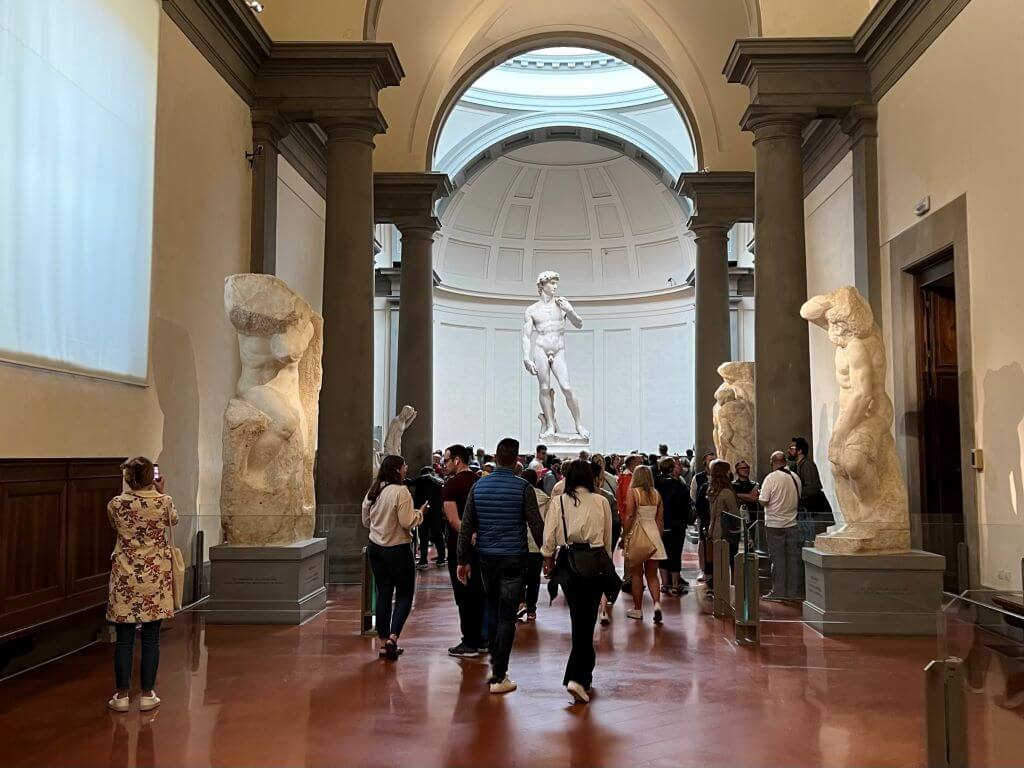
As you exit the first collection in the Accademia Gallery and turn right, you are given an astonishing view. The gallery morphs into a grand hall with various statues on either side before it opens up at the end with a 17-foot-tall statue of shining white marble.
This is it. David is the quintessential Renaissance sculpture, and the main reason for you to visit the Accademia Gallery. It isn’t often a famous work of art lives up to expectations; for me, David exceeded them. Seeing this statue rise above all the people admiring it as he stares into the distance at his enemy is breathtaking.
This massive statue portrays the biblical character David just as he is measuring up his foe, Goliath. David stands in contrapposto, meaning his weight is shifted to one leg as if he is in the act of movement. His muscles bulge and show realistic (if somewhat idolized) tone.
Michelangelo’s display of muscular anatomy on David is immaculate. I work as a physical therapist where knowing this anatomy is a significant part of my work, and I can attest to how incredible David is in this regard. There are small muscles shown I wouldn’t even consider, but Michelangelo took painstaking care to show off his mastery of the human form.


You can see a model of David in its original placement next to the entrance for Palazzo Vecchio.
Accademia Gallery’s Hall of Prisoners
You might be asking yourself, “What about the rest of the statues in the hall leading up to David?” These are Michelangelo’s other highlights in the Accademia Gallery.
These statues are what gives the Hall of Prisoners its name. The Prisoners (sometimes also referred to as Slaves or Captives) are a series of four unfinished marble statues Michelangelo began work on. They were supposed to adorn a grand papal tomb, but the project had to be discontinued for financial reasons.
Now, we’re left with these visually striking sculptures that appear to show people attempting to burst into life from the prison of rock that holds them. It may not sound like much when you read about (I certainly felt that way), but these statues are deeply evocative in person. In a way, these half-finished figures seem to convey more emotion than many finished counterparts. To illustrate this point, scholars also believe these statues symbolize the human struggle to free itself from its physical body in order to reach heaven.
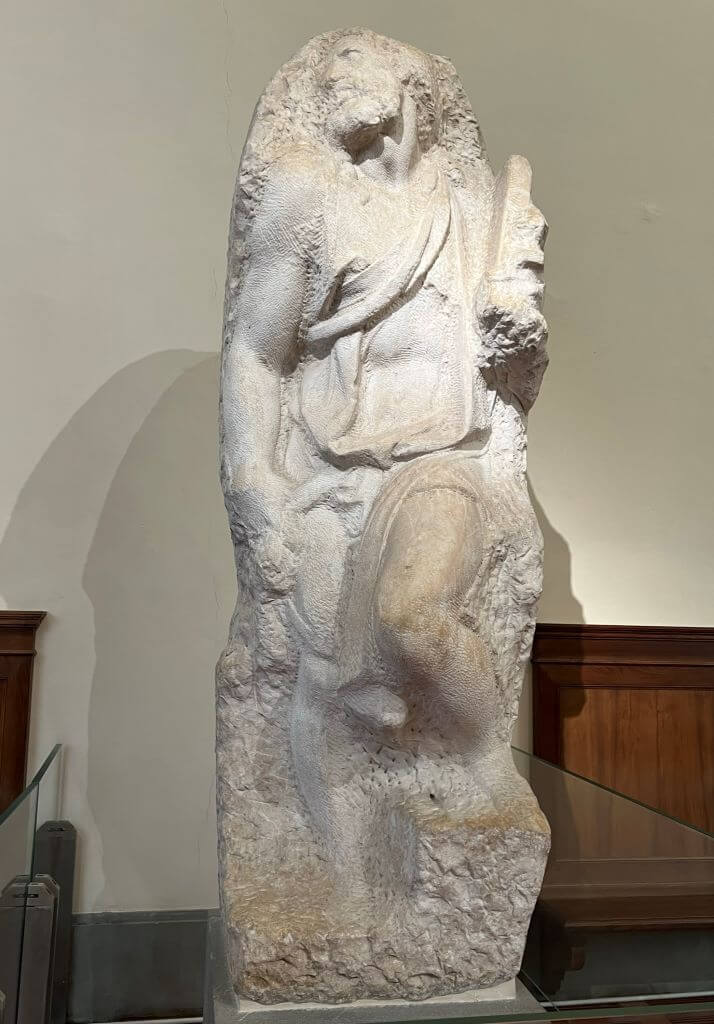
In addition to the four Prisoners, there are two additional unfinished works showing St Matthew and a pietà. These two statues are interesting enough. However, they don’t have quite the same impact as the Prisoners.


You Might Also Enjoy: Palazzo Contarini del Bovolo, Venice’s Hidden Gem
Giambologna’s Rape of the Sabine Women
My final highlight is actually the first you’ll see during your visit of the Accademia Gallery. It’s Jean de Giambologna’s plaster cast of the Rape of the Sabine Women. It’s not only the first highlight, but likely the first thing you’ll notice in the whole gallery as its massive size dominates the room.
The Rape of the Sabine Women tells the mythological story of a time in Rome’s history when its men outnumbered its women. To maintain the growth of Rome, women from nearby towns were kidnapped to become wives of Roman men. The term “rape” in the title is derived from the Latin raptio which means to abduct or kidnap. You may see this called the Abduction of the Sabine Women to avoid the negative connotation of the word.
Interestingly, Giambologna did not have a title in mind when creating this sculpture. His primary goal was to showcase his ability to create and mold the marble to show off his technique which he does wonderfully.
Besides the dramatic size of the sculpture, it is incredibly elegant in its design. Each individual character in the statue is immaculately designed. However, the sculpture is most impressive when viewed from afar. The serpentine figures twist and turn in such a way that it almost seems as if it is one single continuation of the human form.

The original Rape of the Sabine Women can be seen in the Loggia della Signoria across from Palazzo Vecchio with several other Renaissance sculptures.
Visiting the Accademia Gallery
Entering the Accademia Gallery
Tickets can be purchased at the box office at the gallery or reserved online here ahead of time for an additional €4 fee. I highly recommend you reserve ahead of time to guarantee your entry and to skip the line.
Arriving at the Accademia Gallery can be a bit confusing. If you reserved a ticket ahead of time – and again, you really should! – you have to find the ticket office to redeem your email receipt for a physical ticket.
Maybe it’s because I was exhausted after the early morning train ride from Venice, but we had a little trouble figuring out how to enter this museum. There are several people going up and down the road asking if you have your ticket. They seemed like people selling unofficial tickets, so I ignored them. One of them eventually walked up to me, asked if I booked tickets ahead of time, and then pointed me into one of the buildings across from the Accademia Gallery.
Inside the building was a teller who scanned my email and then provided our tickets. The whole process is a little convoluted, but it turns out nearly every big attraction in Florence is like this for some reason.
Moral of the story? Look out for the ticket office almost directly across from the entrance to the Accademia Gallery, and if you don’t see it, ask one of the people calling out about tickets.
Related: A 2-Day Itinerary to Fall in Love with La Serenissima
Accademia Gallery Bag Policy
Large bags and other bulky belongings are not permitted in the Accademia Gallery. However, there is no baggage check in the gallery to check these items.
Conundrum!
Fortunately, there is a place to store your luggage nearby in Piazza di San Lorenzo for €5 per day. If you know you’ll need this service, you can reserve to have your bags stored ahead of time for a slight discount. Click here for reservation info and directions.
Tips for Visiting the Accademia Gallery
Beware of Scammers
Watch where you’re walking around the Accademia Gallery. There are many scam artists around the area laying their “art” (i.e., oil prints) out on the road around the gallery. If you happen to step on one, they’ll confront you saying you owe them the cost of the painting for stepping on the painting.
These scammers are all around looking for unsuspecting tourists. Pay attention to where you’re walking to avoid falling into their trap!
Take Your Time
The Accademia Gallery is surprisingly small, and its highlights are all contained in the same hall making them easy to view. Beyond the hall containing Michelangelo’s statues, there are only a handful of other rooms.
With that said, there’s no rush to move on from the first couple rooms to see David. The Accademia Gallery is the perfect art gallery to take your time to admire the detail of some of the less well-known works on display.
Free Day of the Month
It is free to enter the Accademia Gallery every first Sunday of the month. Reservations are not possible on these days.
While this is a good option to save some money, the gallery will likely be more crowded than usual because of everyone else taking advantage of the waived fees. Personally, I think smaller crowds are worth the €12 entry fee.
More Content You Might Enjoy: Tips and Thoughts for Planning a Trip to Italy
Getting to the Accademia Gallery
Most of the tourist attractions in Florence are within a short walk of each other, and the Accademia Gallery is no different. From the Piazza del Duomo, simply head northeast along Via Ricasoli for about five minutes. The Accademia Gallery will be on your right in a rather nondescript building. The only reason I knew we arrived was because there was a queue of people forming on the outside.
If you are arriving in Florence by train and the Accademia Gallery is your first stop, you have a bit of a longer walk ahead of you but still only around 15 minutes. Head northeast on Via Nazionale and then right on to Via Guelfa. After five blocks, the Accademia Gallery will be on your left at the intersection with Via Ricasoli.
More Tuscany Content: Vino and Hill Towns on a Tuscany Wine Tour
Other Things to do Near the Accademia Gallery
Because Florence is such a walkable city, there is no shortage of things to do near the Accademia Gallery. Here are just a few of the closest things I recommend checking out.
- Florence Central Market
- Basilica of Santa Croce
- Medici Chapel
- Piazza del Duomo
- Uffizi Gallery
Here’s my Florence itinerary to help you plan the rest of your trip!
Thank you for reading this post. Paul Passing Through is a labor of love to which I’ve dedicated a lot of free time. If you’d like to show your support for my blog, you can Buy Me a Coffee to help fund the future of Paul Passing Through. I appreciate any contributions!
Resources to Book Your Trip to the Accademia Gallery
Whether you’re looking for tours, hotels or flights, here are some tools to help get you started planning your trip to Florence!
Look for activities and tours offered through GetYourGuide or Viator!
Search Flights
Still can’t find what you’re looking for? Check out my travel essentials pages for more of my recommendations.
Pin This Post!