The Best of Revolutionary America in Philadelphia’s Old City

Philadelphia’s Old City sits in the middle of Philly’s downtown area and is home to a dizzying number of important historical landmarks. Walking through this part of town feels like walking back in time to the founding of America.
Anchoring Philadelphia’s Old City is Independence National Historical Park where America started. In this historical park, you can visit the the building where the Declaration of Independence and the U.S. Constitution were both signed, Benjamin Franklin’s burial site and a fantastic museum detailing the history of the American Revolution. But those three things are just a small taste of what you can see.
This guide is intended to be a 24-hour tour of Philadelphia’s Old City. Many of the sights are just quick visits with a couple longer attractions in the morning and then mid-afternoon. In busier months, you may opt for some of the tours that weren’t available when we visited in winter. If that’s the case, you may need to modify some of the items I highlight to fit your schedule.
With that out of the way, let’s dive into some of the most iconic landmarks in America!
Disclaimer: This post may contain affiliate links. If you make a purchase through one of these links, I will earn a small commission. This occurs at no added cost to you.
The Museum of the American Revolution
| Hours | Daily 10:00 – 5:00 |
| Length of Visit | 2 – 3 hours |
| Cost | $21 when reserved online |
| Highlights | History of the American Revolution, George Washington’s sword and musket, buttons with the first use of “USA,” photos of people who lived during the period |
It’s a good idea to start your tour of Philadelphia’s Old City with the Museum of the American Revolution, especially if you don’t know much beyond the basics of this time period. This excellent museum does a fantastic job at explaining the history of the revolution to frame everything else you’ll see walking around Old City.
The Museum of the American Revolution tells the story of America’s founding. Its exhibits begin with the end of the French and Indian War and go to the signing of the Constitution.
While the museum has some great objects on display, its real value is in how well it describes the American Revolution. There are many information placards around the museum that describe the events of that time in an engaging way while still providing great detail. It also has some interactive exhibits where you can learn more specifics about important moments during that era if you choose to do so.
Additionally, the museum has two theaters showing short movies on rotation throughout the day. Besides the theaters, there are a few monitors showing brief clips as you walk through the museum.
This museum is perfect for all audiences. My wife and I fall on different ends of the spectrum in terms of interest in history, but we both came away with a positive experience. Even the many children all seemed to be having fun and actively participating in the different learning opportunities presented throughout.


Independence Square
| Hours | Daily 9:00 – 5:00 |
| Length of Visit | 45 – 60 minutes 30 minutes for only Independence Hall |
| Cost | Free Tickets required from March to December ($1 processing fee) |
| Highlights | Independence Hall, Congress Hall |
Independence Square is the highlight of Philadelphia’s Old City and is arguably the most important historical space in America.
There are several buildings here that can be visited, but the main draw by a wide margin is Independence Hall. Do not miss an opportunity to tour this icon of American history.
In addition to Independence Hall, the other two buildings worth seeing are Congress Hall and the Great Essentials Exhibit.
Independence Square is like a miniature version of the National Mall in Washington D.C. To see what I mean, read more about the National Mall here.
Independence Hall
Independence Hall is where America as we know it started. The Revolutionary War may have started in Massachusetts, but America as an independent nation started in this humble hall.
It was in here that both the Declaration of Independence and the U.S. Constitution came into existence. These two documents would change history, both in America and across the globe as they sparked similar revolutions across Europe. A tour of Independence Hall takes you into the room where it all happened.
Most of the building itself is original, but the furniture is almost all replica with the exception of one item. Nevertheless, seeing this tiny room where so many important figures met and debated the future of America is a staggering experience.
Fortunately, the one piece of original furniture happens to be the most important. It’s the chair at the head of the room where George Washington sat when he presided as President of the Constitutional Convention in 1787. Etched into the back of this chair is the image of a half sun.
Throughout the convention, Benjamin Franklin often wondered whether that sun was setting or rising. Once the Constitution was finalized and signed, Franklin was quoted as saying “But now at length I have the happiness to know that it is a rising and not a setting sun.”


Make sure you arrive at least 10 minutes prior to your tour to give you enough time to go through security.
Congress Hall
This building served as the seat of Congress during Philadelphia’s time as the capital from 1790 to 1800. From March to December, tours are provided on a first-come, first-served basis. When we visited in February, the Congress Hall was a self-guided tour.
The ground floor is where the House of Representatives met, and it is the room where George Washington and John Adams were both inaugurated as president. Scattered throughout the room are desks with illustrations and information cards. These help to describe different aspects of the hall, including important events that occurred here and where famous politicians would have sat.
Upstairs is the Senate Chamber with its more intricate furniture and small rooms off the main hall where different committees met. You aren’t free to wander, but you can get close enough to admire the details of each room. There is also a park ranger on hand to answer questions.


The upstairs Senate Chamber closes an hour earlier than everything else in Independence Square. Make sure to see this part of the square first before it closes at 4:00 if you’re visiting around that time.
Great Essentials Exhibit
The Great Essentials Exhibit is a quick add-on to everything else in Independence Square. It’s a small room that contains original copies of the three documents signed at Independence Hall: the Declaration of Independence, the Articles of Confederation and the U.S. Constitution.
As mentioned, these are not the originals but copies from around the time each was signed. Still, there is some historical relevance to two of the documents. The Declaration of Independence is the original copy read to the crowd on July 8, 1776, while the Constitution on display is the copy that was sent to George Washington.
Also on display is the Syng inkstand. This inkstand is believed to be the original used by the Founding Fathers to sign the Declaration of Independence and U.S. Constitution.
The Liberty Bell Center
| Hours | Daily 9:00 – 5:00 |
| Length of Visit | 10 – 20 minutes |
| Cost | Free |
| Highlights | Seeing the Liberty Bell up close, museum exhibits detailing the bell’s history |
The Liberty Bell has been one of the most endearing American symbols since it first rose to prominence in the mid-19th century. It has been used by various groups since that time to call for liberty and freedom for all people regardless of their gender, race or cultural background. In fact, the bell wasn’t even called the Liberty Bell until abolitionists began using the term in 1835.
In addition to its symbolic meaning, the Liberty Bell has an interesting history, and you can learn much of it in the attached museum. For instance, it is commonly believed to have rung on July 4, 1776, at the signing of the Declaration of Independence. While this is pure fiction, it likely did ring on the 8th when a copy of the declaration was read to the public at Independence Hall.
No one is sure when the Liberty Bell’s famous crack first appeared, but there are a few popular myths from over the years. The leading theory is that it cracked when it was rung to announce the passing of Chief Justice John Marshall in 1835. However, there is no evidence to support this, and it is now believed to have cracked sometime between 1841 and 1845.

Fun Fact: The crack you see in the Liberty Bell is from the attempt to repair a much smaller split. To prevent the crack from expanding, they widened it in a technique called stop drilling. Look closely at the crack. You can see small drill holes from when they fixed it. What you see is actually the successful repair!
Philadelphia’s Old City Walk
Those are my top three things to visit in Philadelphia’s Old City, but they are by no means the only things to see. There are many other smaller things to see as you walk around this part of the city. There’s even one other large museum that I excluded from this list, but I’ll write more on that shortly.
Everything here can easily be seen as part of a relatively short walk around Old City. It’s amazing how much history is packed into such a small area!
Carpenter’s Hall
Right across from the Museum of the American Revolution is the southeast corner of Independence National Historical Park. This part of the park has Carpenter’s Hall and a handful of other historic sites, some of which are only foundations of past buildings at this point.
Carpenter’s Hall is the original building where the First Continental Congress met in 1774 to debate how to proceed just prior to the Revolutionary War breaking out. Between its significance and impressive design, it’s easily the highlight of this walk.
You can also wander around this area to see the New Hall Military Museum, America’s first bank and the former space where the Secretary of the Treasury’s office was. The former should be a highlight for Hamilton fans!
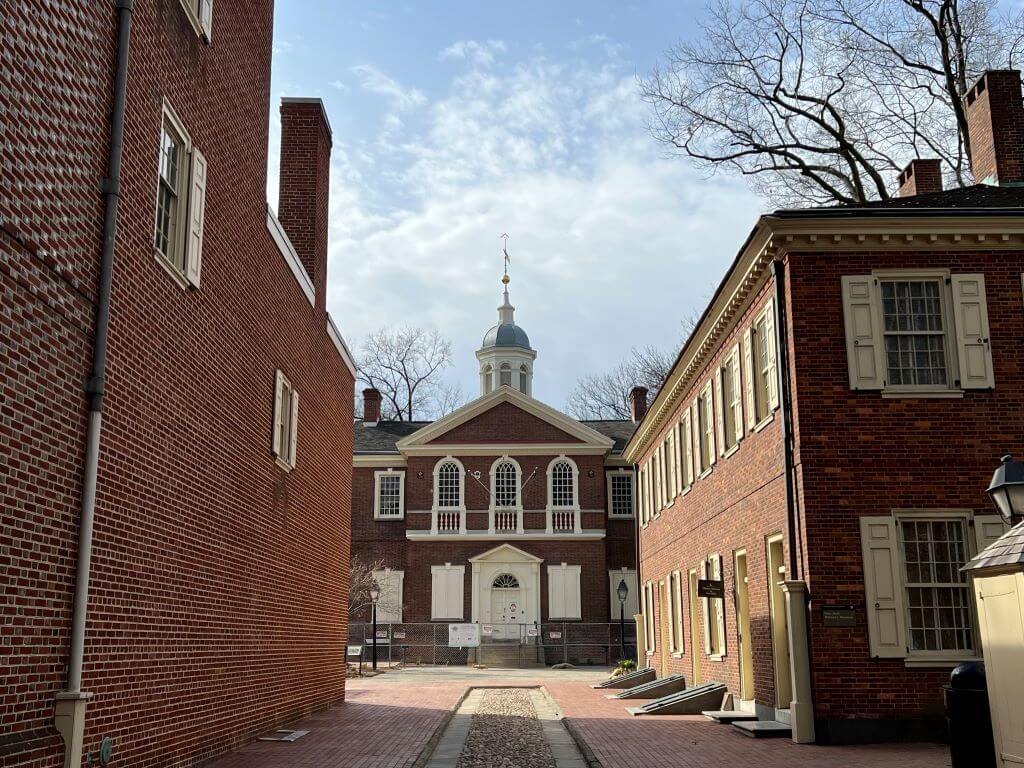
Typically, you can enter Carpenter’s Hall to view a few historical exhibits. Regrettably (and frustratingly), someone started a fire in the basement in late 2022. Because of this and other preservation efforts, the building is currently closed to visitors as they work to repair everything. Some of the exhibits are on display at Independence Visitor Center.
City Tavern
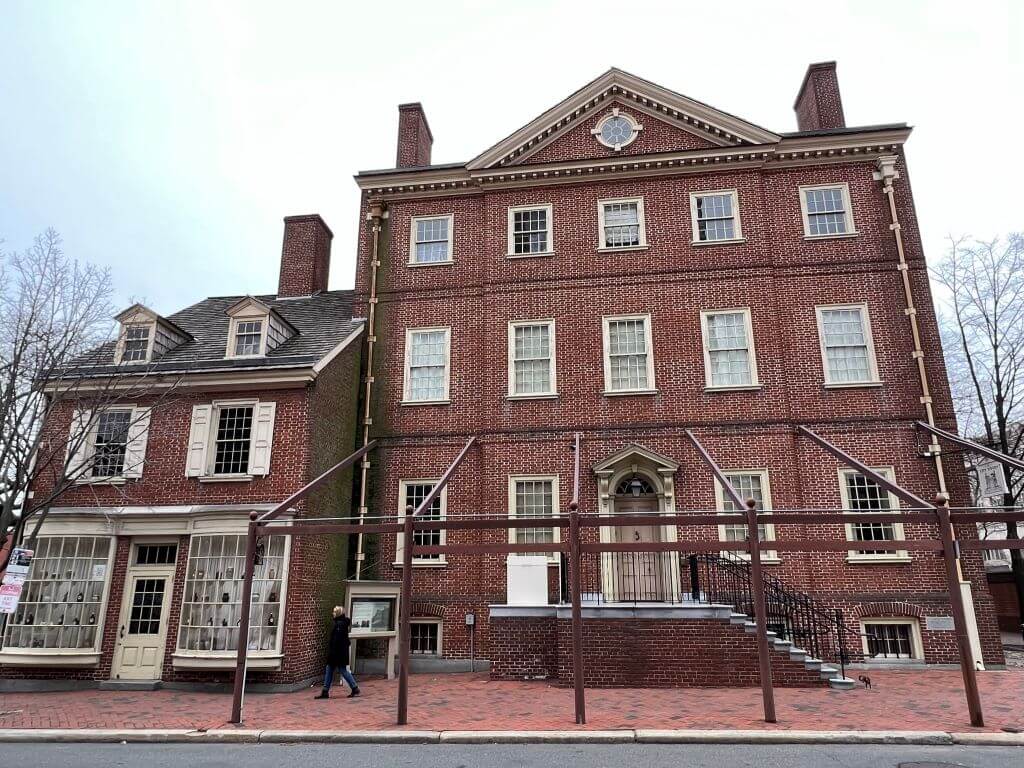
City Tavern is where some of America’s Founding Fathers wined and dined when using Philadelphia to debate the young nation’s future. It served additional functions over the years, including a prison during the Revolutionary War and the army headquarters of George Washington. It even served as the site of America’s first Fourth of July celebration in 1777.
The building you see today is a reconstruction from 1976 after the building was demolished in 1856. Prior to the COVID-19 pandemic, City Tavern had a functioning restaurant for visitors, but they had to close due to the loss of tourism. They are waiting for a new restauranteur to move in.
Powel House
The Powel House is nestled on South Third Street with many other attractive Georgian homes. This house is notable as being the residence of Elizabeth and Samuel Powel during the late 18th century.
The Powels were both wealthy and politically important. As such, they mingled with many of the Founding Fathers during the revolutionary period. The Powels hosted events in this home attended by many of the nation’s most influential figures.
Tours of the Powel House are available from March to December.

Thaddeus Kosciuszko National Memorial
You’d be forgiven if you don’t recognize the name Thaddeus Kosciuszko and are wondering why I included this memorial on my list. Nonetheless, Kosciuszko is one of many unsung heroes from the Revolutionary War.
He came from Poland in June 1776 to help America in its fight for freedom from Great Britian. Kosciuszko was a military engineer who furthered America’s cause by establishing successful defenses in different phases of the war, most notably at the Battle of Saratoga.
The Thaddeus Kosciuszko National Memorial is where he lived for a time after the war and entertained various dignitaries, including Thomas Jefferson. During warm weather months, you can enter the memorial to view a small museum on Kosciuszko’s life.
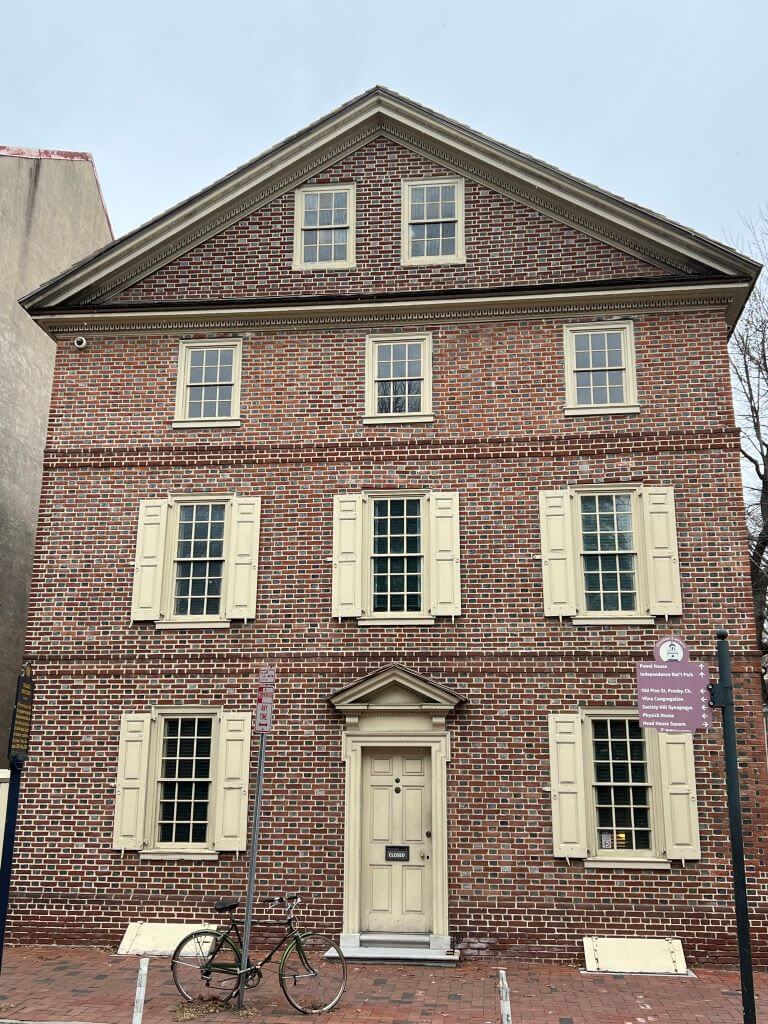
Even if you aren’t interested in seeing these last two relatively unimportant sights, I still suggest taking the time to walk down South Third Street at least as far as Pine Street. The row houses along this road and the intersecting streets are some of the most beautiful in Old City.
Washington Square
Washington Square sits tucked away just behind the more famous Independence Square. As a result, Washington Square is relatively free of tourists.
This park is a peaceful retreat from the busier sights across the road, but it also bears some historical significance, too. Among several other uses, it served as a burial ground for British and American soldiers during the war. It also was the final resting place for people who succumbed to a yellow fever epidemic in 1793.
The centerpiece of Washington Square is the Tomb of the Unknown Soldier. It’s a large memorial near the center of the park with a statue of George Washington and an eternal flame burning to commemorate all those soldiers who died without being identified in defense of the American cause.

President’s House
The President’s House is a blink-and-you-might-miss-it historical site. If not for the other tourists walking around this small space, I would have thought it was some new construction.
As its name implies, these foundations are where the presidential home was when Philadelphia was the nation’s capital. Along its walls are a few exhibits describing the history of slavery in America. It also has some information describing George Washington’s and John Adams’ presidencies, the only two presidents to reside here.
Most of the walls you see are reconstructions, but you can view some of the original foundations that have been excavated.
Declaration House
A short walk from the President’s House is the Declaration House where Thomas Jefferson lived while he wrote the Declaration of Independence.
The current building is a replica from 1975 and is just a small construction on the corner. Still, because of its historical significance, it’s worth the short walk to visit. Tourists can’t enter, but there is a sign describing the building’s significance.

Christ Church Burial Grounds
The last stop on this walk through Philadelphia’s Old City is Christ Church Burial Grounds. By far the most important reason to visit here is to see Benjamin Franklin’s final resting place. Several other notable people are also buried here, including four more signers of the Declaration of Independence.
It costs $5 to visit the burial grounds, but you can see Franklin’s grave from the sidewalk through the fence. His grave is right along the perimeter of the cemetery, so it’s an obstructed view.
What Else is There to do in Philadelphia’s Old City
After several hours of walking and being inundated with historical information, you will likely be done sightseeing for the day. If you’re still up for one more museum or you have another day in Philly, you can add a visit to the National Constitution Center.
The National Constitution Center sits on the far end of the park opposite from Independence Hall. It tells the history of the U.S. Constitution through interactive exhibits and rare artifacts.
If you’re really interested in learning more about the Constitution and how it has shaped America since it was ratified, you should check it out with more time. However, the Museum of the American Revolution does a decent job at introducing the origins of this document. Otherwise, I’m not sure it’s worth it after everything else today.
In addition to the National Constitution Center, Philadelphia’s Old City has plenty more history beyond what I listed. Keep an eye out for the blue historical signs, statues or just anything that looks interesting. With the exception of Washington D.C., I can’t think of another city in America with such a high density of historic sites.
The National Museum of American History in Washington D.C. does a great job at telling the history of the history of the Constitution. Here’s my guide to visiting this extensive Smithsonian museum!
Places to Eat Around Philadelphia’s Old City
Old City has no shortage of restaurants and bars to keep your belly full as you make your way around the neighborhood. Here are the few we stopped at in case you can’t decide where to go!
Istanbul Cafe
Istanbul Cafe is a small coffee shop just a block away from the Museum of the American Revolution. It’s a good spot for a quick breakfast before heading into the museum to start your day.
The cafe has authentic Turkish coffee and some delicious-looking Turkish pastries. They also have a menu with various breakfast bagels, wraps and different types of coffee. Michelle and I each had a tasty sausage and egg bagel.
Red Owl Tavern
Right across the road from Independence Hall is Red Owl Tavern, a modern restaurant with a rustic flair. They have a menu with a variety of options making it hard to settle on one thing. Similarly, there is an extensive cocktail and beer menu.
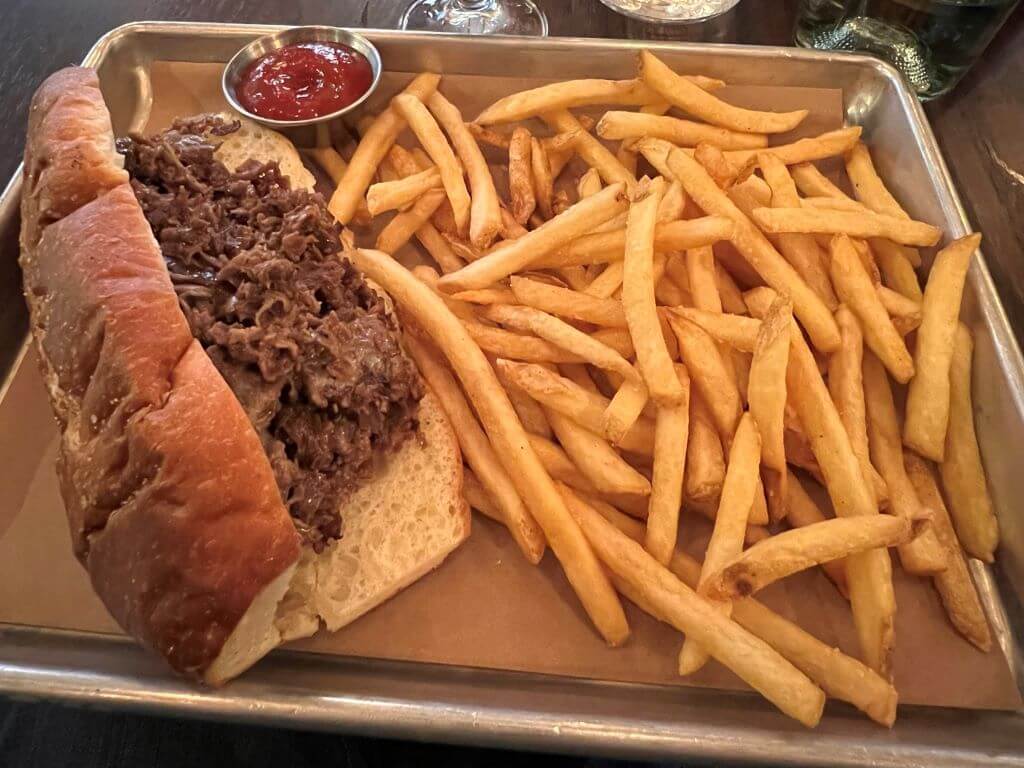
We were there while they had their brunch menu going, and if I could have had everything, I would have. It all sounded so yummy. I eventually settled on the Philly cheesesteak because I had to have one while I was in town. It could have had a bit more cheese, but as a whole, I wasn’t disappointed.
Besides the menu, the service and atmosphere in Red Owl Tavern were both good. Our waitress was pleasant and fun, and there were TVs at the bar showing sports. It was a nice break from all the historical sightseeing we had been doing up to that point.
The Olde Bar
The Olde Bar sits near the City Tavern in the historic Bookbinders building. A restaurant has been in this location off and on in various forms since 1898. It feels like a modern restaurant with old bones.
Regardless of the restaurant’s style, I highly recommend reservations here for dinner. The Olde Bar is a little expensive, but this splurge is so worth it. Everything we had from our pre-meal cocktails to dessert was spectacular!
I had a butternut squash infused old fashioned, which sounds like an odd combination, but it was one of the best old fashioneds I’ve ever had. The butternut squash added a subtle nutty note that made the drink incredibly smooth.
For dinner, we had Olde Bar fries for an appetizer, lobster risotto and lobster pot pie. The lobster in the risotto was cooked to buttery perfection, and the pot pie was simply amazing. I don’t think I can ever look at a regular old chicken pot pie the same way again.
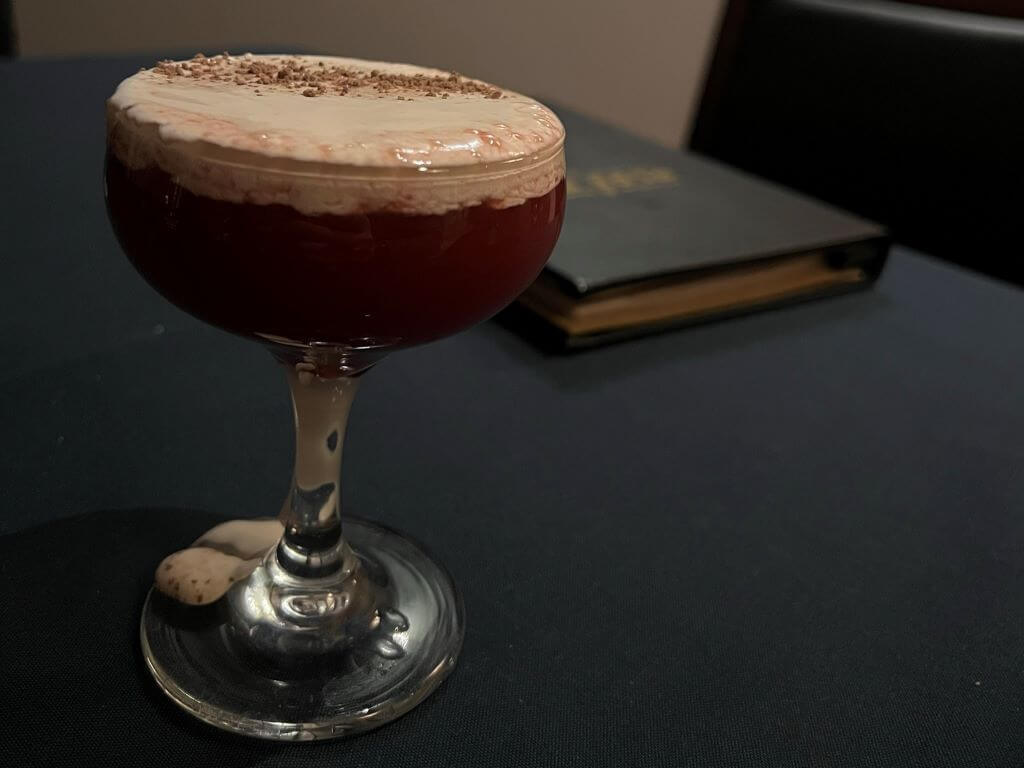
For dessert we had strawberry shortcake martinis and their lemon meringue cake. Much like our dinner, these dessert items were perfect. The martini was just boozy enough to keep it from being cloyingly sweet, and the lemon meringue was a citrusy masterpiece.

Your Day in Philadelphia’s Old City
The contents of this article are only loosely in the order we visited them. In order to make the most of your day and to avoid backtracking, here is the itinerary we followed to make for a smooth visit.
- Istanbul Cafe (breakfast)
- Carpenter’s Hall
- The Museum of the American Revolution
- City Tavern
- The Powel House
- Thaddeus Kosciuszko National Memorial
- Washington Square
- The Liberty Bell Center
- Red Owl Tavern (lunch)
- Independence Hall
- Congress Hall
- The Great Essentials Exhibit
- The President’s House
- Declaration House
- Christ Church Burial Grounds
- The Olde Bar (dinner)
Thank you for reading this post. Paul Passing Through is a labor of love to which I’ve dedicated a lot of free time. If you’d like to show your support for my blog, you can Buy Me a Coffee to help fund the future of Paul Passing Through. I appreciate any contributions!
Resources to Book Your Trip to Philadelphia
Whether you’re looking for tours, hotels or flights, here are some tools to help get you started planning your trip to Philadelphia!
Look for activities and tours offered through GetYourGuide or Viator!
Search Flights
Still can’t find what you’re looking for? Check out my travel essentials pages for more of my recommendations.
Pin This Post!


