Places to Visit in Ancient Rome in One Day

With so many places to visit in Ancient Rome, it can be hard to decide how to plan your trip to the Eternal City. This gets even more difficult if you are limited to how much time you have in Rome.
Of course, you have to see the Roman Colosseum and the Forum. Those two are the obvious choices, but how else can you spend a single day visiting Ancient Rome? Fortunately, many of the best sights, including the Colosseum and Forum, all sit in close proximity to each other, making it easy to see a lot in a day.
In this guide, I’ll take you around my recommendations of the best places to visit in Ancient Rome. By the end of the day, you’ll feel like you walked a mile (or a few miles, maybe) in the sandals of some long-lost Roman senator!
Disclaimer: This post may contain affiliate links. If you make a purchase through one of these links, I will earn a small commission. This occurs at no added cost to you.
Places to Visit in Ancient Rome #1 – The Roman Colosseum
| Hours | Opens daily at 8:30 and closes one hour before sunset |
| Length of Visit | Around an hour |
| Cost | €24 (Full Experience Ticket) |
| Highlights | Arena floor, walking around the amphitheater, exhibits on how the Colosseum was used during the Middle Ages |
The first of my places to visit in Ancient Rome has to be the Roman Colosseum. For practical reasons, visiting this monolith of the human spirit early in the day is ideal if you want to avoid crowds. More importantly, this is the Roman ruin that is most commonly associated with this significant civilization. Like the Greek Parthenon and the Great Wall of China, almost everyone in the world knows what the Colosseum is.
Almost no matter what direction you approach the Roman Colosseum, you’re likely to start getting glimpses of it long before you actually get to it. This is a testament to the size of this 2,000-year-old structure. Most likely, you’ll approach the Colosseum along Via dei Fori Imperiali, where you can also see the ruins of the Imperial Forums underneath you.
Once you arrive at the Colosseum, you’re basically free to explore the amphitheater at your own pace. I recommend purchasing the Full Experience Ticket. This ticket gives you access to the arena floor of the Colosseum. From here, you can get closer views of the Underground area where gladiators prepared and animals were kept for different events.
Besides that, it’s a wondrous feeling to imagine that you’re walking on the same grounds where Roman gladiators once waged battle!
After you’re done in the Arena, your visit takes you to the first level of the Colosseum. Take your time walking around the concourse as you look out onto the Arena. The seats you’re walking through could sit up to 50,000 Roman citizens who came to watch the violent spectacle of the Colosseum’s events. Along the arcade are also some great views of the Arch of Constantine.
Take a moment to linger on the western end of the Colosseum. From here, you can look back at the eastern entrance to the Arena. It’s from this gateway that gladiators and other large animals would be enter the amphitheater.
The last part of your tour is on the Roman Colosseum’s second level. This part of the Colosseum houses a museum detailing the amphitheater’s history. The most interesting exhibits in the museum describe how the Colosseum was used in medieval times. During this era, it saw several iterations including use as housing and later as a sort of castle by a wealthy family.


Did you know? The Roman Colosseum’s actual name is the Flavian Amphitheatre. It wasn’t referred to as the Colosseum till some time after its construction. The Flavian Amphitheatre refers to the ruling dynasty of Rome who had it built.
Places to Visit in Ancient Rome #2 – The Roman Forum
| Hours | Opens daily at 8:30 and closes one hour before sunset |
| Length of Visit | 1 -2 hours |
| Cost | €24 (Full Experience Ticket) |
| Highlights | The feeling of walking back in time to the Ancient Rome era |
If the Roman Colosseum is the most recognizable of the places to visit in Ancient Rome, the Roman Forum is a very close second. Whereas the Colosseum was where Romans went to be entertained, the Forum was where they went to get things done.
You can enter the Roman Forum from three different entrances, but the most common entrance is right next to the Colosseum under the Arch of Titus. As you walk from the Colosseum to the Forum, take a moment to admire the humongous Arch of Constantine. This triumphal arch was built to commemorate an important military victory by Emperor Constantine in 312 A.D.
Once you enter the Forum, you’re more or less free to walk around the ruins in any direction you want. The Forum is filled with Roman ruins in various states of disrepair. It’s a history lover’s playland of columns, temples and grand arches! Cutting through it all is the Via Sacra, the main road through the Roman Forum. Amid the ruins, it’s not hard to imagine yourself walking on the same stones as Roman emperors 2,000 years ago.
Much like Pompeii, visiting the Roman Forum is the type of time warp experience that gives you an idea of what life was like in Ancient Rome.
Make sure to have an audioguide or guidebook handy as you visit the Roman Forum. While the ruins aren’t as sprawling as Pompeii, it’s still easy to get overwhelmed by everything. Further, just visiting the Forum is an experience unto itself, but it will be that much better knowing what you’re looking at along the way.
Also, take advantage of the free water fountains throughout the Roman Forum. Once you leave the entrance area near the Arch of Titus, there is very little shade here. Try to cool yourself down with water as much as you can to make your visit an enjoyable one.


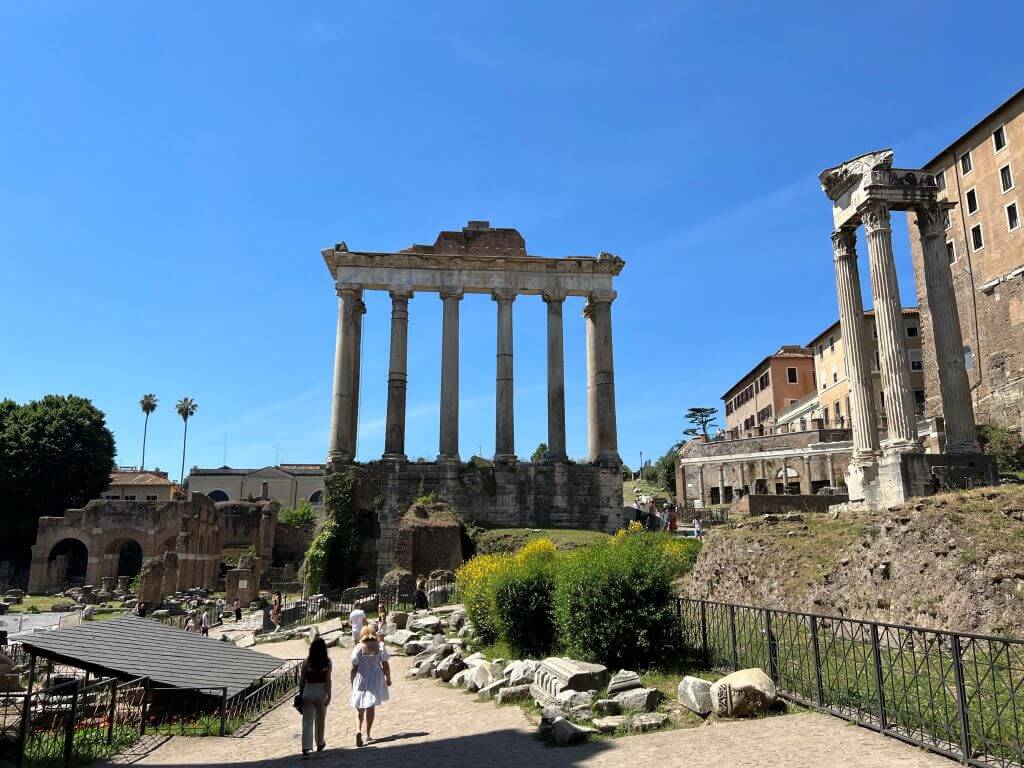
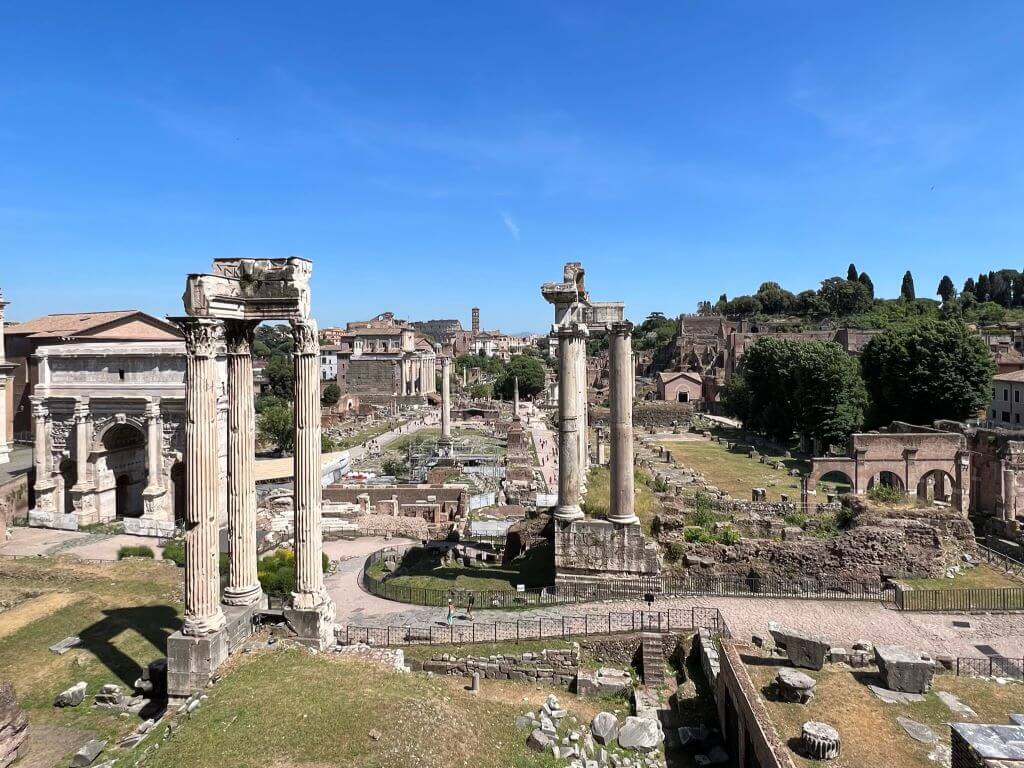
The Roman Forum has so much to see that it’s impossible to cover in an overview like this one. Be on the lookout for a post later this month with a much more comprehensive guide dedicated just to the Forum!
Places to Visit in Ancient Rome #3 – Palatine Hill
| Hours | Opens daily at 8:30 and closes one hour before sunset |
| Length of Visit | 30 – 60 minutes |
| Cost | €24 (Full Experience Ticket) |
| Highlights | Views of the Forum, a quiet stroll through Roman ruins |
Rising over the Roman Forum’s western edge is Palatine Hill. While it may seem like it’s part of the Roman Forum, it technically isn’t.
Starting with Emperor Augustus in 27 B.C., Palatine Hill is where Roman emperors lived. Ruins of buildings created by these emperors can still be seen today.
Perhaps more importantly, this hill is considered to be where Rome had its start. Excavations have found ruins dating to 1,000 B.C. around when the city is believed to have been founded. In fact, the mythological figures of Romulus and Remus, the supposed founders of Rome, have strong ties to Palatine Hill. Two locations from the legend are believed to be here: the cave where the twins were suckled by a wolf and the ruins of a hut where Romulus lived.
Whether you believe all that or not, it’s still worth visiting for great views of the Forum and the Colosseum, as well as to walk around the evocative ruins largely devoid of other visitors. Some of the things you can see are the emperor’s private stadium, the Circus Maximus where chariot races were held, and a museum housing objects found on the hill.
And remember, entrance to Palatine Hill is included in your ticket to the Roman Forum, so you may as well check it out!

If you have anything in particular you want to see, find it on a map and head to it first. We visited Palatine Hill right after doing both the Colosseum and the Roman Forum. I wanted to see the Circus Maximus, but we didn’t plan very well and just ended up wandering around. The heat and fatigue from earlier in the day prevented us from seeing the one thing I most wanted to visit.
Places to Visit in Ancient Rome #4 – Capitoline Hill and Museum
| Hours | Daily 9:30 – 7:30 |
| Length of Visit | 1 -2 hours |
| Cost | €16 |
| Highlights | Views of the Forum, Boy Extracting a Thorn, Capitoline She-Wolf, Statue of Marcus Aurelius on a horse |
After spending the morning walking among Ancient Rome’s ruins, the Capitoline Museum is the next of my places to visit in Ancient Rome. Overlooking the northwestern end of the Roman Forum, this museum contains many of Ancient Rome’s best statues and artworks.
One of the best parts of visiting the museum is just the walk up to the entrance. You ascend a dramatic staircase, appropriately named Michelangelo’s Grand Staircase, to the top of Capitoline Hill. At the top, you’re met with three palatial buildings surrounding a large replica statue of Emperor Marcus Aurelius on his horse. It’s the type of grandiose design that Italy has mastered over the centuries.
The museum itself comprises the two buildings on the left and right of the equestrian statue plus an underground tunnel that connects the two. From this underground passage, you’ll visit the Tabularium. The Tabularium was built in the 1st century B.C. to act as Rome’s archives, but today visitors pass through here to see great views of the Roman Forum below.
Once you enter the museum, take your time and focus on the highlights. The museum’s layout is a bit confusing, but the best pieces are generally housed in large, central spaces. The first of these spaces is a courtyard housing remnants of the Colossus of Constantine, a 4th century A.D., 12-meter-high statue of Emperor Constantine.
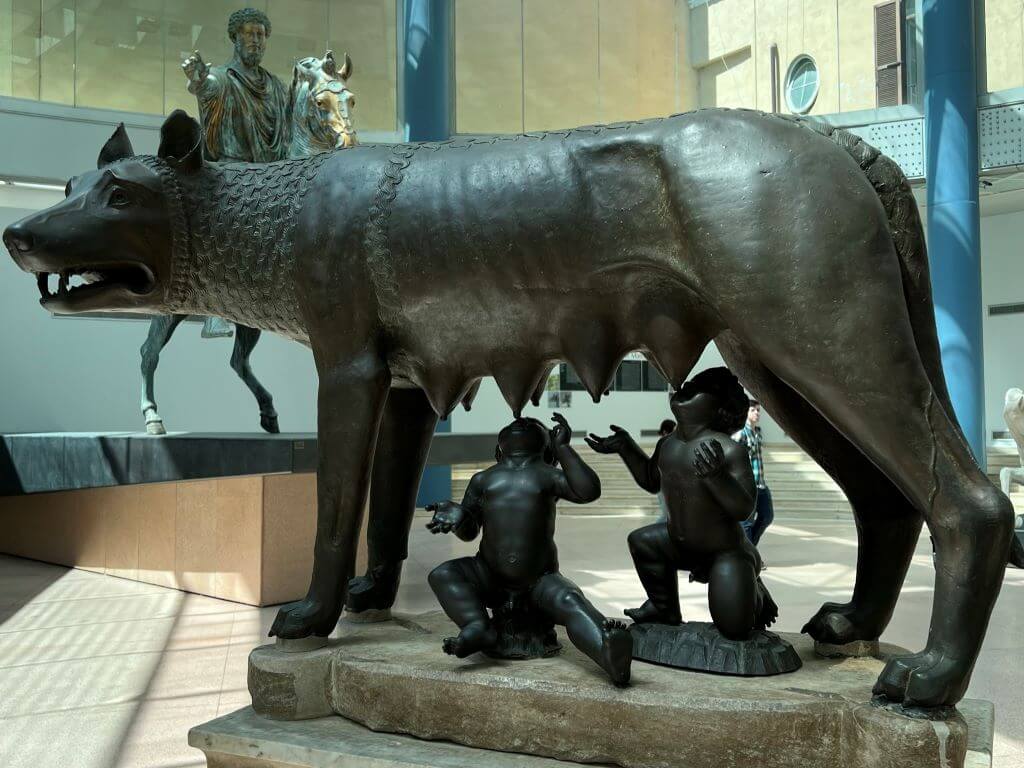
Shortly after this courtyard, you’ll enter a large room containing several of the Capitoline Museum’s best statues. This room includes the famous Capitoline She-Wolf, the Boy Extracting a Thorn, and the original statue of Marcus Aurelius atop his horse.


Places to Visit in Ancient Rome #5 – Imperial Forums
| Hours | Opens daily at 8:30 and closes one hour before sunset |
| Length of Visit | 30 – 60 minutes |
| Cost | €24 (Full Experience Ticket) |
| Highlights | Trajan’s Market, Trajan’s Column, walking over the forums at night |
Finally, the last of my places to visit in Ancient Rome. This stretch of Ancient Roman ruins extends along Via dei Fori Imperiali, the road that goes from the Victor Emmanuel Monument to the Colosseum.
These ruins contain the remains of various public areas from Ancient Rome. They’re similar to the Roman Forum but no single one is as large or as culturally significant. Still, if you have time, the Imperial Forums may be worth visiting since they’re included in any ticket that includes the Roman Forum.
On the other hand, you can easily see these ruins without a ticket as you walk along Via dei Fori Imperiali. This is how I experienced the Imperial Forums, and considering everything else there is to see in Rome, I’m not sure I would recommend actually walking among the ruins unless this is a repeat visit for you.
Probably the most popular of the Imperial Forums is Trajan’s Market. Walking towards the Colosseum, Trajan’s Market will be one of the first sections of ruins on your left, just a little past Trajan’s Column. These market ruins contained various shops for Roman citizens and offices for bureaucrats of the empire. It’s a remarkably well-preserved semicircular building that gives a brief look into the daily life of Ancient Romans.

Return to Visit Ancient Rome at Night
Whether this is your visit to Rome or your hundredth, I recommend coming to these Ancient Rome sites at night. These places to visit in Ancient Rome are perhaps best seen at this time of day. Seeing the ruins at night when they’re aglow with floodlighting is a totally different experience than seeing them in daylight.
Besides being empty of the throngs of daytime visitors, the ruins have a magical feeling about them at night. It’s a romantic atmosphere that makes the ruins come alive. You can almost hear the chatter of Romans from centuries gone by as you walk through the area under the nighttime sky.
You won’t be able to visit the Roman Forum, but you’ll be able to walk along the Imperial Forums and around the Colosseum. Don’t miss this once-in-a-lifetime opportunity!


See All These Places in Ancient Rome with the Full Experience Ticket
Buying tickets for the Roman Colosseum and the Forum isn’t as straightforward as you think. If you search online for tickets, you’re met with an overwhelming number of vendors. Even within those many vendors, you’re still faced with a wide variety of ticketing options.
First of all, buying a ticket ahead of time is an absolute must. Without a pre-booked ticket, you can expect to wait in long lines almost no matter what time of day you arrive to visit the Roman Colosseum or the Forum. Further, I suggest booking your tickets as soon as you know your itinerary. Because of the Colosseum’s popularity, tickets can sell out fast, especially in peak tourist season.
The official ticketing site is Coop Culture, and this is the site I recommend for the cheapest price and most security when purchasing your tickets.
By purchasing the Full Experience Ticket, you get access to the Colosseum Arena, the Roman Forum, Palatine Hill and the Imperial Forums. What’s more, you have 48 consecutive hours to visit these sights.
There are other tickets available, but the Full Experience Ticket gives you most bang for your buck.
Even though Coop Culture is the official site, tickets including the Colosseum tend to sell out very quickly. This can make it difficult to get tickets for some people. If that is happening to you, then the safest bet may be to book a guided tour.
Frequently Asked Questions When Visiting Ancient Rome
Where should I stay nearby?
We had a lovely stay at Arch Rome Suites. It’s a very short walk to the Pantheon and about a mile along mostly flat road to the Colosseum. Despite this close location to the Pantheon and being next to a couple cafes, it’s in a relatively quiet alley. This combined with the spacious and comfortable rooms made Arch Rome Suites a perfect location during our stay as we were able to come back in the mid-afternoon for a relaxing break from the heat and get a good night’s sleep each day.
In addition to its location, Arch Rome Suites also offers modern furnishings and an included continental breakfast each morning. It lacks any old-world charm, but it more than lacks up for that with everything else!
When is the best time of the year to visit Rome?
I’ll answer that by saying when the worst time to visit is. The summer months from June to August see the most tourists and the highest temperatures. If you can avoid visiting during summer, do so.
That said, I’m fully aware not everyone is able to do that. So, if you have to visit during summer, try to go to Rome in June. It still may be pretty busy, but you’ll hopefully avoid the hotter months of July and August. Better yet, if you can do the shoulder months of May or September, they could be good options, too.
What are other places to visit in Ancient Rome?
You certainly have no shortage of places to visit in Ancient Rome in addition to the ones I mentioned above. The obvious sight I didn’t mention is the Pantheon, which is just a brief walk from everything described above.
Some other places to visit include the Baths of Caracalla, Castel Sant’Angelo, Aqueduct Park and the Catacombs of Priscilla.
More Posts for Planning Your Trip to Italy
Here are some of the other itineraries I’ve written to help you plan your dream trip to Italy!
Thank you for reading this post. Paul Passing Through is a labor of love to which I’ve dedicated a lot of free time. If you’d like to show your support for my blog, you can Buy Me a Coffee to help fund the future of Paul Passing Through. I appreciate any contributions!
Book Your Trip to Rome
Whether you’re looking for tours, hotels or flights, here are some tools to help get you started planning your trip to Italy!
Look for activities and tours offered through GetYourGuide or Viator!
Search Flights
Still can’t find what you’re looking for? Check out my travel essentials pages for more of my recommendations.
Pin This Post!