
The Best of the Roman Empire in Campania, Italy
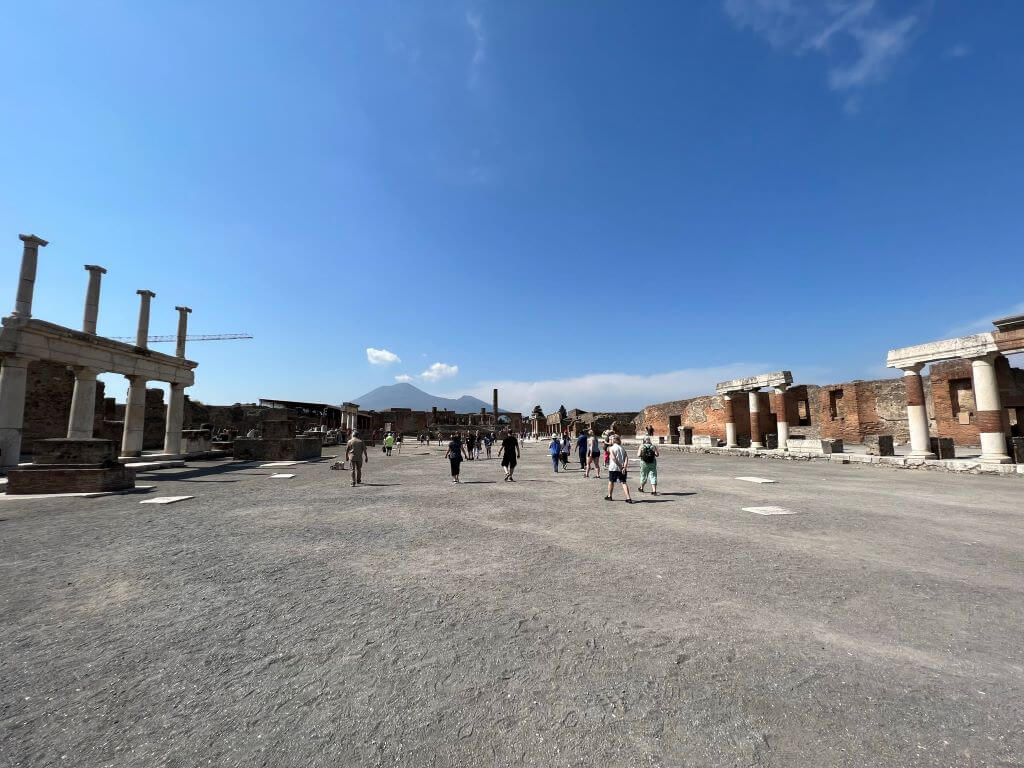
Tourists coming to Italy to see Ancient Rome should look no further than Campania. This region just south of Rome has a number of Roman sites, but the most well known are easily the lost cities of Herculaneum and Pompeii. Since their discovery in the 18th century, people have been coming here to experience what life was like for Roman citizens during the height of their empire.
Besides Pompeii and Herculaneum, visitors can also tour the Naples National Archaeological Museum where many original artifacts from the cities are stored. With enough time, you can even hike up Mount Vesuvius for a firsthand view of this legendary volcano.
This guide takes you through the highlights and practical tips you need to know for visiting each of these historic locations. I’ll also provide the logistical info you’ll need to put the whole trip together!
Disclaimer: This post may contain affiliate links. If you make a purchase through one of these links, I will earn a small commission. This occurs at no added cost to you.
Orientation to Campania, Italy
Campania is one of Italy’s 20 official regions, sitting in the southwest part of the country just below Rome. The region is famous for the gritty streets of Naples, the sun-soaked beaches of the Amalfi Coast and its delicious food, but it is Campania’s historical importance that is one of its biggest draws.
Throughout its history, Campania has been home to three major civilizations: Etruscan, Greek and Roman. As such, it’s home to 10 of Italy’s 58 UNESCO World Heritage Sites and has ruins aplenty for tourists interested in the past. Campania’s most important ruins, and some of the most popular in the world, are those of Pompeii and Herculaneum.
Pompeii and Herculaneum were Roman cities ruined by Mount Vesuvius in 79 A.D. Due to the sudden, violent nature of the eruption, both cities were left ruined in remarkably pristine condition. What’s more, these sites, the volcano that ruined them, and the Naples National Archaeological Museum, which houses many of the artifacts from Pompeii and Herculaneum, are all within just 16 miles of each other.
The Eruption of Mount Vesuvius
On an October day in 79 A.D., Mount Vesuvius erupted, bringing devastation to the region. The region experienced two large earthquakes in the prior decade and even some smaller tremors in the days leading up to its eruption. However, no one expected the mountain they lived under to erupt. It’s questionable whether they even knew Vesuvius was a volcano.
Pompeii received the initial brunt of the eruption due to wind patterns at the time pushing ash and debris in its direction. The larger debris destroyed many of the rooftops and taller structures in the city. While there were some casualties during this early part of the eruption, many Pompeiians were able to escape.
Meanwhile, Herculaneum was largely spared during the first several hours of the eruption. Some minor ash deposits occurred, but because of the direction of wind that day, most debris fell southeast of Vesuvius towards Pompeii. Still, most of its citizens evacuated due to this ashfall.
Herculaneum’s good fortune during the eruption thus far wouldn’t last, though. Overnight, the volcanic column collapsed causing a series of six pyroclastic surges off the mountain. These events devastated Herculaneum and Pompeii. Any remaining citizens were instantaneously killed by the intense heat of these surges, and the two towns were eventually covered in ash (20 meters deep in the case of Herculaneum and 6-7 meters deep in Pompeii).
Owing to the eruption, both cities effectively became lost to time. Some looting happened in Pompeii, but more eruptions over the years further buried the cities, making them even less accessible. It was because of these eruptions that we now have these two remarkable windows into Roman life.
Naples National Archaeological Museum
| Hours | Daily 9:00 – 7:30 Closed Tuesdays |
| Length of Visit | 1.5 – 2 hours if focusing on the highlights listed below |
| Cost | €22 |
| Highlights | The Secret Room, the Farnese Collection, many original artifacts from Pompeii and Herculaneum |
With the rediscovery of Pompeii and Herculaneum in the 18th century, the king of Naples, Charles of Bourbon, had both sites excavated and their treasures brought to Naples to boost the city’s prestige.
From that point forward, many of the statues, frescoes and other items of significance ended up in the Naples National Archaeological Museum for safekeeping. This makes the Naples National Archaeological Museum one of the world’s best museums of ancient antiquities.

Because of the popularity of this museum, tickets should be purchased ahead of time to guarantee your entry and let you skip the line.
Visiting the Museum
The Naples National Archaeological Museum contains a large collection of historical objects. Its top highlights are from the Roman Empire. These include the Farnese Collection from Rome and a number of items from Herculaneum and Pompeii. In addition to these collections, the museum also has objects from pre-Roman times, with the most notable being from Egypt and Greece.
Asides from the interesting Farnese Collection, plan to focus your time on the exhibits focusing on Pompeii and Herculaneum. The museum is huge, and if you are visiting either Pompeii or Herculaneum later in the day, you’re likely to get burnt out if you try to see too much here.
The museum has a fairly straightforward layout that makes it hard to miss anything. Objects from Pompeii and Herculaneum start on the first floor (fellow Americans, remember that in Europe, what we refer to as the second floor is the first floor). The original Dancing Faun and Battle of Alexander as well as many less important but no less stunning frescoes from the House of the Faun are on this floor. You can also see the Secret Room on the first floor, a room filled with phallic statues, erotic art and explicit frescoes that don’t leave much to the imagination.
On the second floor, the rooms generally flow from one into the next. Each room is filled with an assortment of frescoes, statues and various everyday items recovered in the cities. The highlights on this floor are just to the right of the grand staircase in the rooms containing artifacts from Herculaneum’s La Villa dei Papiri. These rooms contain two scorched papyrus scrolls owned by Julius Caesar’s father-in-law, who lived in this villa. A number of bronze statues are also on view here, including the enigmatic Five Dancers.


When to Visit the Naples National Archaeological Museum
If possible, I recommend visiting the museum before you head to either Herculaneum or Pompeii. Doing so helps to provide some context to the mostly bare ruins you’ll see later.
Walking around the ruined towns gives you a sense of what a thriving Roman town looked like at its peak. It’s an amazing experience to walk along their roads, go in and out of the many buildings, and to wonder what it must have been like to live here. Yet, with some notable exceptions, you aren’t able to get an idea of what their cultural values were and how they went about their day-to-day lives.
The museum helps to fill in those gaps that the ruins can’t. All the objects tell the story of how these people lived and what they appreciated in life. Without this museum, you’d be missing a vital part of the story.
If nothing else, seeing the museum helps you to imagine what the ruins would have looked like while you are actively there. Between that and learning more about their culture, I think it only makes sense to do the museum first.
Getting to the Naples National Archaeological Museum
From Naples’ main train station, Napoli Centrale, you can either walk or take the metro to the museum. The metro runs two different lines from the train station to the museum. You can take either line 1 to the Museo stop or line 2 to the Cavour stop. Tickets for each can be purchased at newsstands or tobacco shops.
You could also do the 1.5-mile walk to the museum if you want a quick glimpse into the chaos that is Naples. Simply head west out of the station towards Corso Giuseppe Garibaldi. From there, turn right till the road branches and continue along Via Cesare Rosaroll. When that street ends at Via Foria, turn left till you come to the museum.

Regardless of how you get to the museum, be careful and hold on to your possessions. I hate to contribute to Naples’ reputation of being unsafe, but the very first thing I saw when exiting the station was two people handing off a cell phone that had clearly just been pickpocketed.
Neapolitan Pizza Around the Museum
Since this was our only time in Naples, it was imperative we try some pizza in the city where it was created. Fortunately, the famous Via dei Tribunali is just a few blocks away from the museum.
Along the length of this 0.5-mile road you’ll find no shortage of pizza places (and many other things if you don’t want pizza). Besides the pizza, walking along this road gives you an interesting slice (pun intended) of Neapolitan life if you only have this brief time in the city.
We eventually settled on La Vera Pizza Napoletana as it was one of the first pizzerias we walked by with outdoor seating. It was also reasonably crowded with what appeared to be mostly locals enjoying their lunch break – always a good sign.
We ordered two pizzas to share: a margherita and one with mushrooms. After a very short wait, both were delivered, and they were delicious! I had read about how unique Neapolitan pizza was compared to all other pizzas, but reading about it and tasting it are two different things. The sauce was delightfully sweet and the texture of the inner half of the pizza was soupy rather than crusty. The texture was a surprise, yet I quickly got over the shock once I tasted how good it was.
Whether at La Vera Pizza Napoletana or elsewhere, do not miss a chance to taste real Neapolitan pizza in its birthplace while you’re here!

The Ruins of Pompeii
| Hours | November – March Daily 9:00 – 5:00 (last entry at 3:30) April – October Daily 9:00 – 7:00 (last entry at 5:30) |
| Length of Visit | At least 2 – 3 hours but you could easily spend several hours here |
| Cost | €18 |
| Highlights | The Forum, House of Menander, House of the Faun the brothel, House of the Vettii, Baths of the Forum |
Pompeii is the more famous of Mount Vesuvius’ victims from its eruption in 79 A.D. Prior to its demise, Pompeii was a thriving port town filled with middle-class Roman citizens living under what they thought was just a mountain.
When Vesuvius erupted, rock and other debris from the volcano covered the city, destroying the rooftops of the buildings. Over the course of the next 24 hours, pyroclastic surges flowed into the city, killing whoever remained and covering the city in layers of ash and debris 6-7 meters deep. Some looting occurred, but it was largely preserved until its discovery in the 18th century.
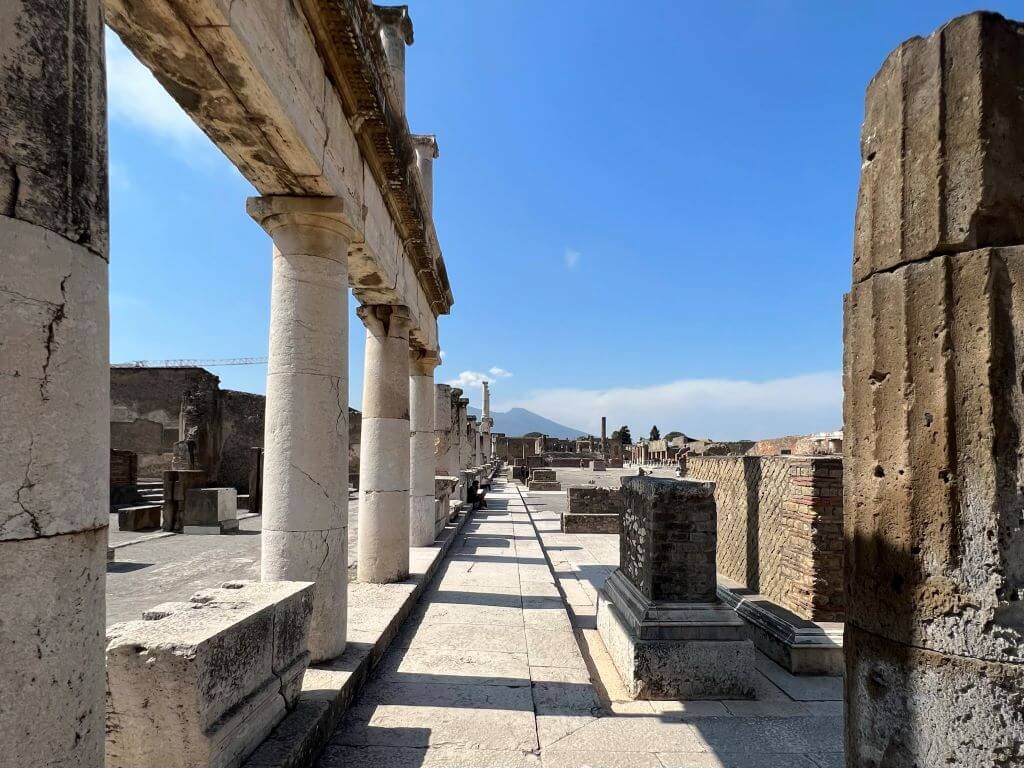
Here is my full guide for visiting Pompeii to help with your visit!
Visiting Pompeii
If you aren’t doing a guided tour, pick up a map when you first walk in. This will be your best friend as you explore the ruins. You’ll quickly realize that the park is much bigger than you realized, and it doesn’t have much in the way of signage. Even with a map, it can be hard to quickly orient yourself, but it would be next to impossible without one.
In fact, I recommend doing a guided tour of Pompeii if possible, especially if it’s your first time visiting. Even with a map and research beforehand, it’s too easy to miss things. With a guided tour, you can be assured that your guide will show you the highlights.
Regardless, once you pick up your map and walk through Porta Marina, you’re essentially free to explore the ruins. Some areas will be roped off, but otherwise, you can walk in and out of the ruins at your leisure. This is one of the things I enjoyed most about Pompeii. Even though it meant I got lost several times, it was so neat walking around looking at the random walls and courtyards wondering what might have been there 2,000 years ago.
Pompeii has a number of things to see, and you could easily spend an entire day here without seeing everything. Nevertheless, here are a few of the highlights I think you should try to make a point of seeing.
The Forum is the most photographed part of the park. You literally can’t miss it if you walk in from Porta Marina. It contains a huge number of ruined governmental and religious buildings around its perimeter.
The House of the Faun contains two of the most examplary pieces of art from Pompeii: the Dancing Faun and the Battle of Alexander. These are only replicas (the originals are in the Naples archaeology museum), but it’s still interesting to see them where they would have sat originally.
The House of the Tragic Poet contains my favorite mosaic in the city. It’s the ancient equivalent of a beware of dog sign. While not historically important, it’s a fun reminder that these were people just like us.
The House of the Vettii was the home of two former slaves who became wealthy merchants. This home contains a large number of well-preserved frescoes and statues.
The Brothel is a reminder that sex sells and that that’s always been the case. Inside are a number of sexually explicit frescoes. It’s unclear if these frescoes were meant to be decorative or to showcase what customers could purchase.
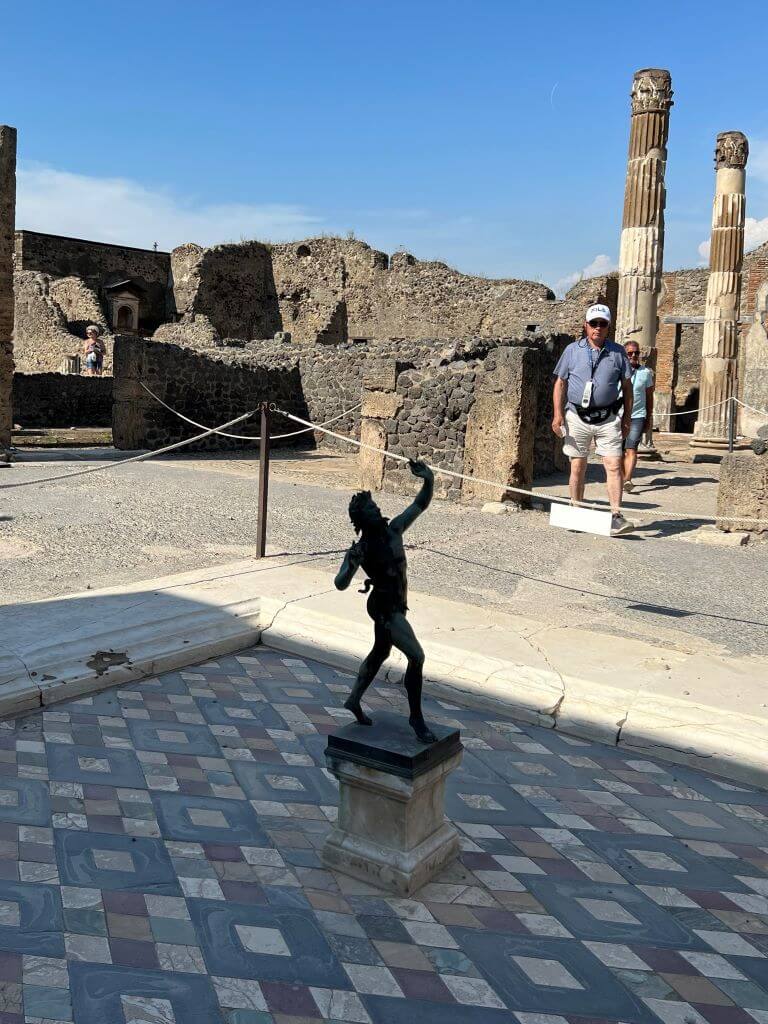

Don’t forget to bring sunscreen, sturdy walking shoes, a hat or sunglasses, water and light fitting clothes! Pompeii is very hot and you’ll be doing a lot of walking. Take care of yourself to help make your visit enjoyable.
Getting to Pompeii
Like everywhere else in Campania, the Circumvesuviana regional train is likely your best option. For the main entrance to the ruins, get off at the Pompei Scavi-Villa dei Misteri station.
If you are coming from Naples or Herculaneum, be sure to board a train heading towards Sorrento. If you are coming from the south, any train you board will go by Pompeii on its way to Naples.
Once you arrive in Pompei (that’s not a typo, it’s the spelling of the modern-day town), you have three entrances to choose from. Porta Marina is the main entrance right next to the train station. As its the main entrance, you can find several amenities here including a bathroom, bag storage and a bookshop. It is also open till 7:00, which is 90 minutes longer than the other two entrances.
A little farther down is Piazza Esedra, generally used by tour groups. In Pompei’s city center is Piazza Anfiteatro for those staying in town.

The Ruins of Herculaneum
| Hours | Daily 9:30 – 7:30, last entry at 6:00 Closed Wednesdays |
| Length of Visit | 2 – 4 hours |
| Cost | €17 |
| Highlights | More intimate setting than Pompeii, well-preserved frescoes and ruins |
Smaller but wealthier than Pompeii, Herculaneum was an ancient resort town for well-to-do Romans. It was destroyed by the same eruption of Mount Vesuvius in 79 A.D. as Pompeii, but the eruption affected Herculaneum differently.
Unlike Pompeii, Herculaneum avoided the heavier rockfall of the first hours of the eruption. It later succumbed to several pyroclastic surges that covered the city in 20 meters of debris. As a result of the sequence of those events, Herculaneum was left immaculately preserved with many of the buildings keeping their roofs. Further, because of how deeply it was covered, potential looters were never able to gain access to it like they did with Pompeii.
I didn’t personally visit Herculaneum because we only had one day in the area. However, a request on Twitter for someone to provide an idea of what it’s like visiting Herculaneum led me to Derek.
Derek L. is the host and creator of the Hellenistic Age Podcast, a show dedicated to the ancient world from Alexander the Great to Cleopatra. He visited Herculaneum in September 2022. Here’s what he has to say about it.

Visiting Herculaneum
You begin with a long, steady descent into the ruins, as the ancient city has sunk below the modern landscape. Herculaneum can be thoroughly explored in about 2-3 hours. In part, this is due to its compact nature. Additionally, the organization of the site’s landmarks makes navigation far more straightforward than its often-intimidating neighbor, Pompeii.
At the entrance, I recommend that you pick up one of the free handbooks they offer. This booklet gives a list of each of the 47 landmarks in Herculaneum, including their approximate location on the map and its identification number. It also has a paragraph giving context to what you’re looking at. The sequence of landmarks in the book is what you will generally follow once you’re inside, but you can also use it as a checklist should you venture out of order.
Frescoes are abundant in Herculaneum, with rooms painted a menagerie of colors like red, yellow, and occasionally some blue. Mosaics line the floors, depicting various patterns or scenes from Greco-Roman mythology. The most spectacular of these artworks is in the House of Neptune and Amphitrite, showing the sea-god Neptune and his wife Amphitrite standing side-by-side.
At some point, the decorations begin to blur into each other once you’ve explored several houses. Still, walking through these living spaces from nearly two millennia ago is a remarkable experience.
Leaving behind the homes of its inhabitants, a handful of civic monuments dot Herculaneum’s landscape. One of the first sights is the statue of Marcus Nonius Balbus. He was a major patron of the city in the late first century B.C., whose statue and inscription greet you as you enter.
The scant remains of the Augusteum, a sanctuary devoted to images of deified emperors, occupy one area. You can also get a unique insight into the day-to-day activities of Herculaneum, with a number of surviving shops and food stalls available to browse. One of these shops, the Ad Cucumas, was a wine vendor, whose advertisements have stood the test of time on its customer-facing wall with prices and available wines.


Getting to Herculaneum
The regional Circumvesvuiana is the easiest way to reach Herculaneum. Ercolano Scavi is the nearest station.
If you’re coming from Naples, make sure to board a train heading towards Sorrento. It doesn’t matter which train you board coming from south of Herculaneum as they will all go by Herculaneum on their way back to Naples.
Mount Vesuvius
| Hours | Opens daily at 9:00 throughout the year November – February closes at 3:00 March and October closes at 4:00 April – June and September closes at 5:00 July – August closes at 6:00 |
| Length of Visit | 3 – 4 hours including transportation to the entrance |
| Cost | €11.68 |
| Highlights | Atmospheric hike around the crater rim, views of the coast, chance to see smoke coming out of the crater |
Hiking up Mount Vesuvius is by no means a must when visiting this part of Campania. All the history from its eruptions is seen in the ruins or the Naples National Archaeological Museum. Nevertheless, visiting the volcano is a great addition to your itinerary if you have the time to spare.
The hike up the mountain takes you through an eerie volcanic landscape and rewards you with looks into the crater and fabulous views along the coastline.

Make sure you purchase tickets for the park well in advance. They sell timed entry reservations, and they do sell out. What’s worse, if you take a bus up without a ticket or miss your time, you’ll get turned away and have to wait around till the bus leaves, typically two hours later.
Vesuvio Express
Unfortunately, it does require some logistical finagling to get to the crater if you don’t have a car. There are a handful of options, each with their own pros and cons. I eventually opted for the Vesuvio Express.
The Vesuvio Express is a bus service that takes you from the nearby Ercolano Scavi train station up the park’s entrance. They run several buses hourly throughout the day. The drive each way takes about 30 minutes, and then you have two hours to hike up and explore the rim of the crater.
I was a little nervous about Vesuvio Express after reading some of their reviews, but none of the other services seemed much better. It also worked best for my itinerary. My whole experience with Vesuvio Express ended up being satisfactory. It wasn’t anything special, but it got me up and down the mountain at my reserved time, which was all I needed.
You can purchase tickets from their website. They offer tickets for the transfer plus park entrance for €27 or just the transfer for €12. If you purchase only the transfer, be sure to give yourself enough time for the bus to ascend the mountain based on your park reservation time.
At Mount Vesuvius’ Crater
Once you arrive at the parking lot, your driver will tell you what time to be back, and then you’re free to explore. The park has a small shop before the entrance with water and a bathroom. The bathroom is only for paying customers, but as it’s the only bathroom in the park, you should pick up a water or something else small just to be safe.
After you use the restroom and go through the ticket turnstile, it’s a roughly 30-minute hike uphill to the crater rim. The trail is pretty even, but it is all on loose, ashy dirt. If you have mobility issues, you may want to consider bringing hiking poles.
The park itself has an eerie beauty about it. It’s covered in a brownish orange soil with volcanic rocks of various sizes scattered everywhere. Not much grows beyond some scrubby grass and other scraggly plants growing out of some of the boulders around the rim.
As you climb, the views out to your right are stunning. You can see all along the Bay of Naples from Naples to Sorrento. The hike takes longer than it should because of how often you’ll stop to look out at the coastline.
At the crater rim, you can walk around to admire the different views down into the crater or the Bay of Naples. The crater is 300 meters deep with a diameter of 450 meters. It’s impressive to behold and consider what devastation it would bring if it would erupt again. Wispy smoke coming out of the crater doesn’t do much to ease those concerns!
Along the crater, you can also stop at a couple small shops selling souvenirs, water, wine or beer if you want to sit with a drink while you admire the landscape.


Keep in mind that you are at an elevation of more than 4,000 feet where you’re exposed to the sun for the entirety of the hike. Don’t forget to bring water, sunscreen and a hat or sunglasses.
Campania Artecard
The Campania Artecard could be a good option to help cut costs if that’s a concern. This combo ticket comes in three varieties, but the three-day card is the one with the most value based on this guide.
The three-day Campania Artecard costs €32 and includes free access to two attractions, 50% discounts on other attractions and Circumvesuviana fares throughout the region.
Don’t forget to price out your trip before purchasing. For example, since we were only visiting the Naples National Archaeological Museum and Pompeii, it wasn’t cost-effective for us to purchase this pass.
How Long to Stay in Campania, Italy
First things first, I do not recommend doing Pompeii and Herculaneum in one day. Technically, you could do the Naples National Archaeological Museum, Herculaneum and Pompeii all in a single day, but why would you do that to yourself?
We opted to skip Herculaneum altogether. I would have liked to see its ruins, but especially after Pompeii, I was all ruined out.
I consider the Naples archaeology museum and Pompeii to be must-sees. If that’s all you’re interested in seeing, you can easily do so in a single day. However, if you want to add on Mount Vesuvius or Herculaneum, you need at least an extra half day. To do all four, plan on two days.
Where to Stay in Campania, Italy
Where to stay for this part of Italy depends on the rest of your itinerary, where you came from, and where you’re going next.
For our trip, we stayed in Pompei for a couple reasons. This part of our Italy trip was bookended by Orvieto and Sorrento, and we split up for a few hours on our second day here. I took the Circumvesuviana back up the coast to hike up Mount Vesuvius while Michelle took the train south to Sorrento. Because of this, Pompei made the most sense for us.
Pompei is by no means a must-see town for tourists. If it weren’t for the ruins right there, it would just be any old town, but because of the park, it has a decent, albeit touristy infrastructure (hotels, cafes, lots of souvenir shops, etc.). That said, we did find a nice bar to have a couple drinks and then a really good restaurant for dinner, so it’s not bad for just a night’s stay.
Hotel Santa Caterina
We stayed at Hotel Santa Caterina. Much like the rest of Pompei, it was good enough for a night, but I wouldn’t want to stay here for much longer.
Overall, it wasn’t a bad hotel, but it definitely felt dated and worn out. It was pretty inexpensive compared to the rest of Italy, so considering the price, it’s not bad for a night.
The room was about the size of a small studio apartment without the kitchenette. It had a living area with a sofa, a large bedroom and big bathroom. On the plus side, the beds were comfortable, and it was very spacious. One big negative, though, was the bathroom. It wasn’t the dirtiest bathroom I’ve ever seen, but I was glad I only had to shower in it once.
Asides from the room, Hotel Santa Caterina has a decent included breakfast on their rooftop. It’s standard continental fare like most of the other hotels we stayed at in Italy. The rooftop is nice to sit outside in the sun, but don’t expect any grand views.
Dinner at Add’ù Mimi
If you do stay in Pompei, check out Add’ù Mimi for dinner. Unlike most of the restaurants along Pompei’s main street, this restaurant is not at all touristy. It’s on a side road off the main drag through Pompei, just across from Hotel Santa Caterina.
The service was a little brusque. It was by no means bad, but it seemed like maybe they weren’t used to tourists. Regardless, the food was so good that it was easy to look past this slight issue. Everything was very cheap, too, which was another great perk.
I had gnocchi sorrentina while Michelle had tagliatelle with prawns. We also shared a grilled swordfish. Everything was very good, but the star was the gnocchi. Being American, I’m most familiar with southern Italian food traditions since this is where many immigrants came from. This gnocchi was exactly what I was used to. Whether it was the ambience of actually being in Italy or the quality ingredients, it was even better than anything I’ve had in America!
Getting Around Campania, Italy
The easiest way to get around the region is by the Circumvesuviana train. This regional train starts in Naples’ Garibaldi Station (itself on the bottom level of Napoli Centrale) and runs south along the coast towards Herculaneum (25 minutes away) and Pompeii (35 minutes away). Tickets for the Cirumvesuviana train can be purchased at the station, and trains run roughly twice an hour.
If you’re going south from Naples, make sure you are on a train going towards Sorrento since some of Circumvesuvia’s split off in other directions. The trains aren’t always clearly marked, so ask someone to be safe. If you are going towards Naples, you can safely board any train.
Naples to Herculaneum’s station, Ercolano Scavi, takes about 15 minutes. Naples to Pompeii’s station, Pompeii Scavi, takes about 35 minutes.
Another option is the Campania Express train. These trains also leave from Garibaldi Station and are more direct than the Circumvesuviana. However, while direct, these trains only run four times per day.
Frequently Asked Questions About Campania
Can you do any of this as a day trip from Rome or the Amalfi Coast?
You can do parts of this guide as a day trip from either area, but you would not be able to do everything in a single day. If you only have one day, don’t even consider hiking up Mount Vesuvius – it isn’t worth it. You could do any two of the other sights, though.
My recommendation is the museum and Herculaneum or Pompeii. I think the museum is vital to gaining a better understanding of the ruins, so I wouldn’t skip that. Additionally, doing both ruins on the same day is too much. You’ll run the risk of getting ruin fatigue (kind of like museum fatigue but less pretentious).
I can only do one. Herculaneum or Pompeii?
It depends what kind of experience you’re looking for. Herculaneum is much smaller, but it’s less crowded and better preserved. On the other hand, Pompeii is still very well preserved compared to other similar ruins, and it impresses visitors with its size. Pompeii is also the more culturally iconic of the two, which lends an emotional element to a visit.
When should I visit?
To avoid crowds and heat, try to visit during the shoulder seasons or winter. Peak tourist season is from May to August. This time of year corresponds with some of the hottest months, too. Further, weekends and mid-to-late morning tend to be busier times. We visited Pompeii around mid-afternoon on a Monday and were surprised by how uncrowded it was.
More Posts for Planning Your Trip to Italy
Here are some of the other itineraries I’ve written to help you plan your dream trip to Italy!
And don’t forget to check out some of my tips and thoughts when it comes to planning a trip to Italy.
Thank you for reading this post. Paul Passing Through is a labor of love to which I’ve dedicated a lot of free time. If you’d like to show your support for my blog, you can Buy Me a Coffee to help fund the future of Paul Passing Through. I appreciate any contributions!
Resources to Book Your Trip to Campania, Italy
Whether you’re looking for tours, hotels or flights, here are some tools to help get you started planning your trip to Campania, Italy!
Look for activities and tours offered through GetYourGuide or Viator!
Search Flights
Still can’t find what you’re looking for? Check out my travel essentials pages for more of my recommendations.
Pin This Post!