
My Free Self-Guided Colosseum Tour in Rome
Like the Eiffel Tower, Taj Mahal and the Great Wall of China, the Roman Colosseum is one of the most recognizable places in the world. A visit to Rome almost certainly means a visit to the Colosseum is in the offing. And I have you covered with my free self-guided Colosseum tour.
Despite the Colosseum’s size, it’s a surprisingly easy and compact visit. These two facts make it perfect for a self-guided tour. You could spend your money on a tour, but why do that when you can save some cash with my self-guided Colosseum tour.
So, lace up your shoes and grab your camera, we’re going on a tour of the monumental Roman Colosseum!
Disclaimer: This post may contain affiliate links. If you make a purchase through one of these links, I will earn a small commission. This occurs at no adtded cost to you.
History of the Roman Colosseum
Before you start your self-guided Colosseum tour, it’s important to know a bit of history for context.
Emperor Vespasian began construction of the Roman Colosseum in 72 A.D. The land used for the construction was part of a former complex owned by the previous emperor, Nero. Vespasian intended for the Colosseum to act as a gift to the people of Rome.
The majority of the Colosseum was finished eight years later by Vespasian’s son, Titus. Emperor Titus held the first games in either 80 or 81. Further construction was undertaken by Emperor Domitian, Vespasian’s younger son. Domitian had more seating added to the Colosseum and the underground built to house animals, slaves and gladiators during events.
The final stats of the Colosseum are still impressive today. It held over 50,000 people (some records suggest it could seat 87,000, though) and is the largest freestanding amphitheater ever built despite being nearly 2,000 years old. Further, the Colosseum measured 615 feet long, 510 feet wide, and a height of 157 feet. It covered an area of 6 acres!
Romans came to the Roman Colosseum to see gladiator fights, executions, animal hunts and reenactments of important Roman battles. For a time, the arena floor could even be flooded for staged naval battles.
Interestingly, the Colosseum wasn’t originally known by this name. Ancient Romans likely referred to it simply as amphitheater. The name Flavian Amphitheater, referring to the ruling dynasty that had it built, is likely came after the fall of the Rome. Researchers believe the name of the Colosseum stems from a large statue of Nero known as the Colossus of Nero that was housed near the amphitheater.
With the decline of the Roman Empire, the Colosseum saw less and less use. During the Middle Ages, it saw various uses. At different times it was used as a chapel, a cemetery, housing, workshops, a castle and a hideout for bandits. Its stonework was also used as building material for other construction around Rome.
Beginning in the late Renaissance period, the Catholic Church began to take a proactive role in preserving the Colosseum. In the 20th century, preservation of the Colosseum accelerated, with the state taking an active role in its maintenance in the 1990s.
My Self-Guided Colosseum Walking Tour
| Hours | Opens daily at 8:30 and closes one hour before sunset |
| Length of Visit | 60 – 90 minutes |
| Cost | €24 (Full Experience Ticket) |
| Highlights | Arena floor, walking around the amphitheater, exhibits on how the Colosseum was used during the Middle Ages |
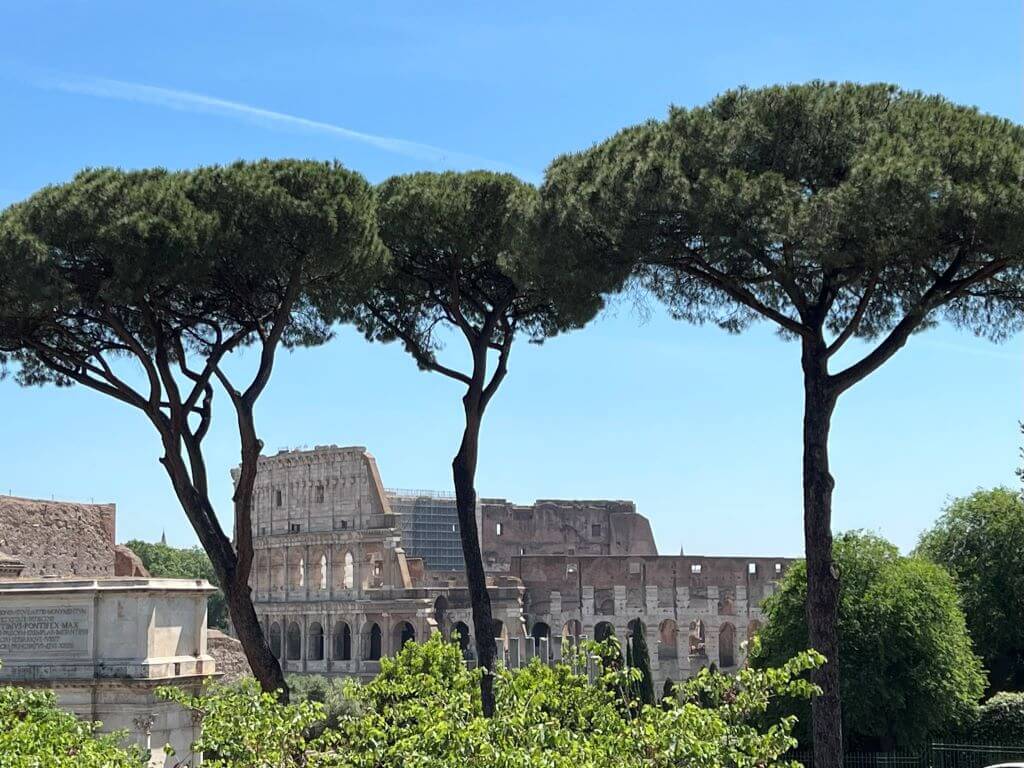
Regardless of how you’re approaching the amphitheater to start your self-guided Colosseum tour, you’re going to start to see it in distance before you get to it. Take a second to consider how this monument to Ancient Rome would have looked during Rome’s peak.
Spectators coming up to the Colosseum were greeted by a massive, dazzling white structure. Large statues from Roman mythology stood in the arches on the upper levels, and a 100-foot bronze statue of Nero greeted visitors at the Colosseum’s entrance. It would have been a sight unlike anything contemporary Romans would have ever seen.
Now, while still impressive, the Colosseum is all brown, unadorned rock and the statue of Nero is gone. The statue would have been in the same spot as the cypress trees near the entrance on the west end of the amphitheater. If you’re having a hard time finding the entrance, just look for the line of people and tour guides holding flags.
Don’t worry too much about walking around the whole structure. The most dramatic view of the Colosseum is as you approach from Via dei Fori Imperiali. Other than that, the rest more or less looks the same. It can still be interesting to see, but you should wait till after you tour the inside to see how much time you have left.
My self-guided Colosseum tour is based on the Full Experience Ticket. For more info on purchasing this ticket, scroll down to the ticketing section. You can also book an additional tour of the Underground and top level of the Colosseum. With access to the Arena, you get good views into the underground area, though.
The Start of My Self-Guided Colosseum Tour
Have your ticket handy so you can skip the line. Today, employees scan your ticket and send you on your way. 2,000 years ago, they would have given you a pottery shard telling you where your seat was.
As you enter to start your self-guided Colosseum tour and take your first steps through the ground level, take note of all the entrances and stairways leading to different seating sections. The passageways leading to the seats were known as vomitoria. This was all designed to allow for the 50,000 spectators (some sources say up to 87,000 people could fit in the Colosseum) to leave their seats and exit the stadium within minutes. Vomitoria means a rapid discharge and is where our word vomit comes from.
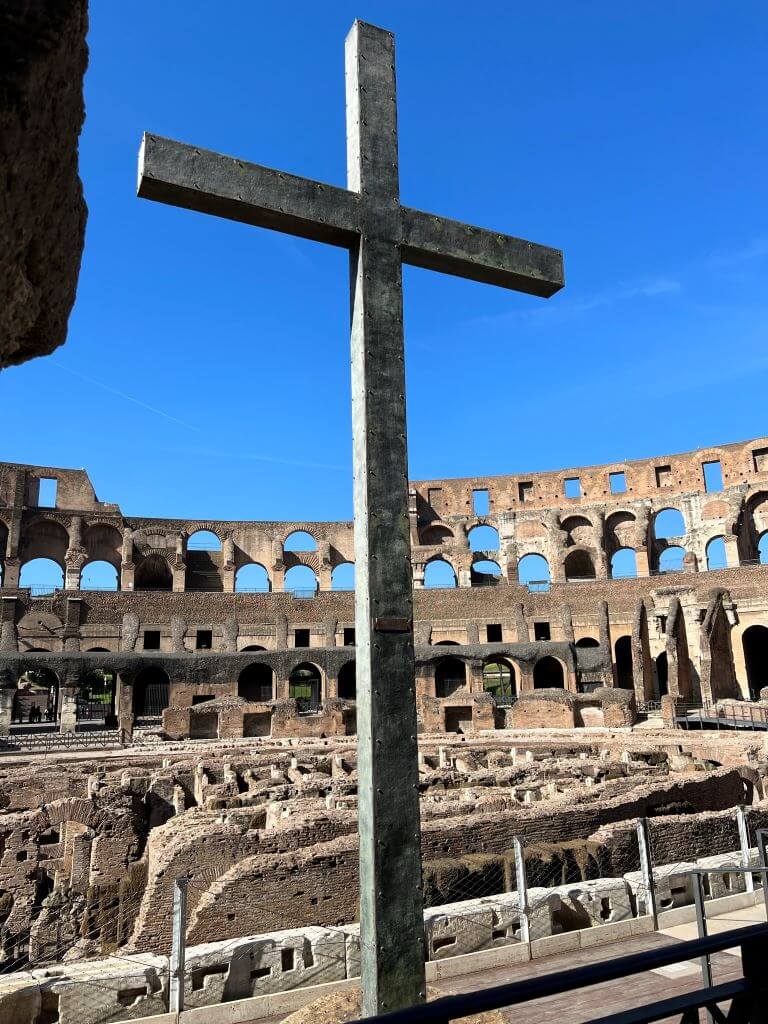
Within a few minutes of walking through the ground level, you’ll come across a large Christian cross on the north side of the Colosseum. This cross was placed here in 2000 by Pope John Paul II to commemorate Christians who were martyred here during public executions. However, modern research questions whether early Christians were executed at the Colosseum or at nearby sites.
The placement of this cross has a symbolic meaning, as well. This was where the Roman emperor sat, the person who had the ultimate say regarding who lived and who died in the arena below. Roman emperors also ordered the execution of thousands of Christians up till the reign of Emperor Galerius.
Self-Guided Colosseum Tour Stop #1 – The Arena
You’ll eventually come to the eastern entrance of the Colosseum’s Arena. This was the same entrance used by gladiators and large animals like elephants. It’s a little surreal to think that you’re entering into the Colosseum from this same gateway. If you listen hard enough, you can almost hear the roar of the crowd as you make your way into the arena.
Once you’re on the Colosseum Arena floor, take a second to just stop and look around. Imagine being a gladiator walking into the Colosseum wondering whether you were in the final moments of your life while thousands of Roman citizens scream at you. It’s a sobering feeling.
There are a few things to look at from the arena floor. The most obvious is the view of the Colosseum from the bottom up. It’s a view of the Flavian Amphitheater not many get to see. Take time to soak it in.
To your right at the center of the Colosseum is the emperor’s seating area. This is where the cross you saw earlier sits. Opposite from that on the Colosseum’s southern side is where the Vestal Virgins sat. The Vestal Virgins were a select group of six women chosen to be the priestesses of the goddess Vesta. They had the important function within Roman society of keeping the sacred fire of Vesta burning all year round. It was believed that Rome’s empire would end if the fire went out.
Just to the right of the gateway where you entered are remnants of the last remaining marble seats in the Colosseum. Now, envision the entire seating area looking like that!
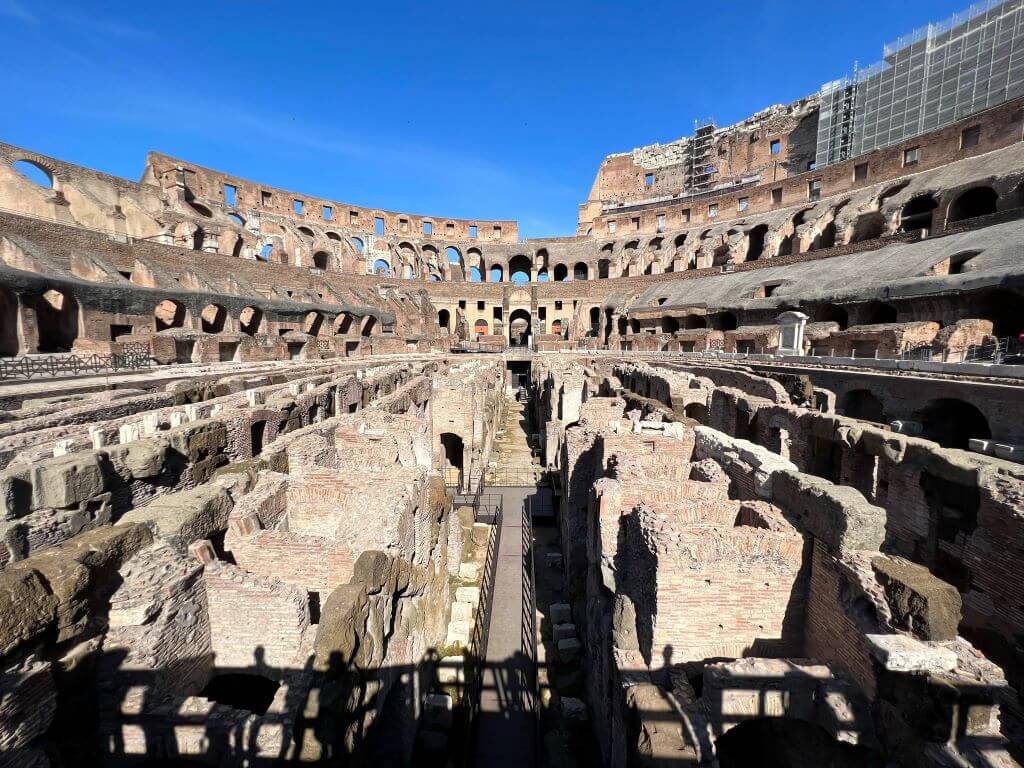
After you’re done pretending to be a gladiator and admiring the Colosseum, it’s time to look into the Colosseum Underground. This section of the Colosseum is where wild animals, gladiators and prisoners were kept during the games. It’s mostly just a seemingly random maze of walls and tunnels, but this space would have been a chaotic mass of humanity and animals during events.
If you’re looking into the underground area, towards your left is one of the elevators where animals or prisoners could have been raised to the arena floor during the games.

Self-Guided Colosseum Tour Stop #2 – The Second Level
After you’re done in the Colosseum Arena, your next stop on your self-guided Colosseum tour is the second level of the amphitheater. This part of your tour is pretty straightforward.
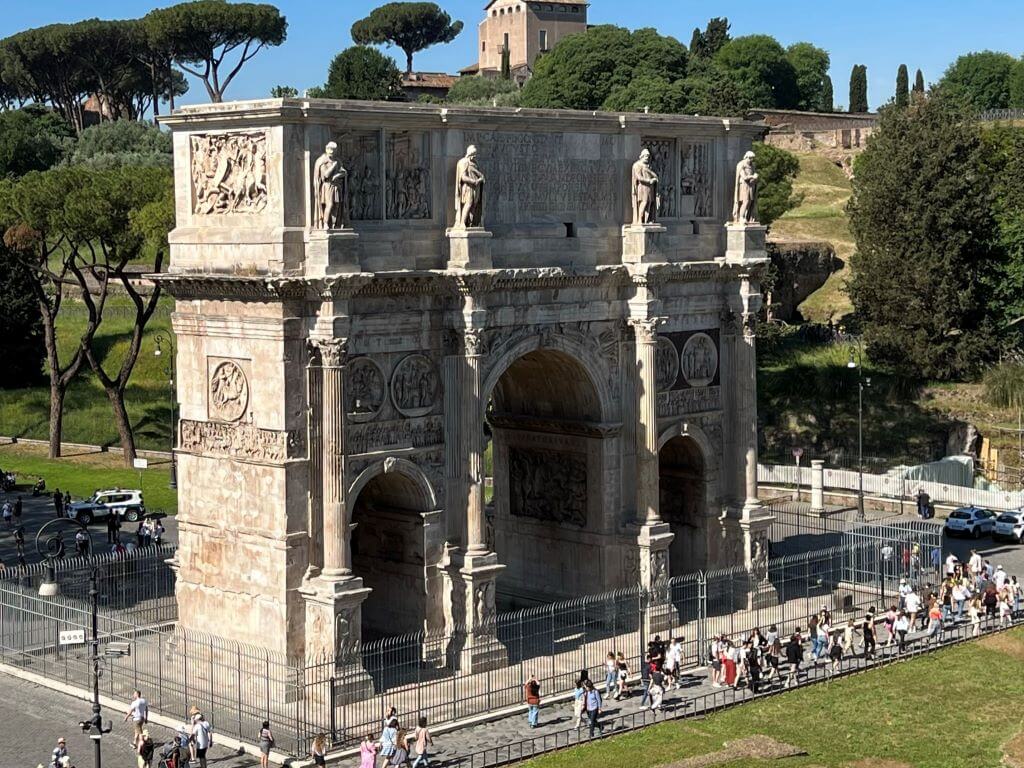
You’ll walk around the majority of the second level taking in views of the Colosseum. Along the way, you can step out through different sections to admire different parts of this area of Rome. One of these sections, in particular, is worth checking out along the Colosseum’s southwestern edge. From here, you can get some great views of the Arch of Constantine and bits of the Roman Forum and Palatine Hill in the distance.

Self-Guided Colosseum Tour Stop #3 – The Museum
The last part of your self-guided Colosseum tour is the small museum on its third level. While the museum may seem like a bit of an afterthought, it actually has some interesting exhibits.
The museum details the Roman Colosseum’s history from its inception through the modern era. It has artifacts and detailed replicas on display to give you a better idea of what the Colosseum looked like on a more up-close level.
I especially enjoyed the sections on how the Colosseum was used during medieval times. It’s always so fascinating to me to see how people took these now legendary structures and adapted them to their needs during their own times. The Colosseum was no different in this regard.
While walking through the museum, you’ll learn how the Colosseum was used at different times as a chapel, housing, workshops and a hideout for bandits. At one point, it was even used a makeshift castle by the Frangipani family in the 13th century.
Make sure you save a bit of energy for the museum to get a better perspective of the Colosseum over the years!
Once you’re done in the museum, you’re basically done in the Colosseum. As you make your way out, you’ll get one more spot where you can get a good look of the underground and the Gladiator’s Gate from the Colosseum’s western end. Take this last moment to see some more of the underground and to reflect on everything you just saw.

Return to Visit the Colosseum at Nighttime
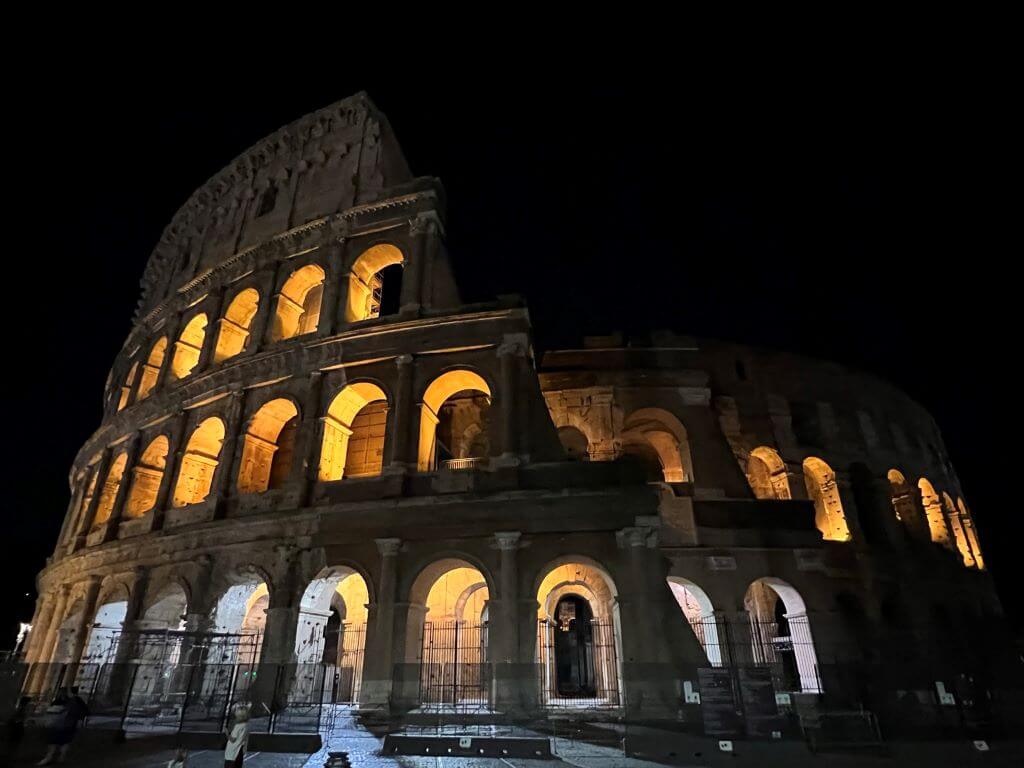
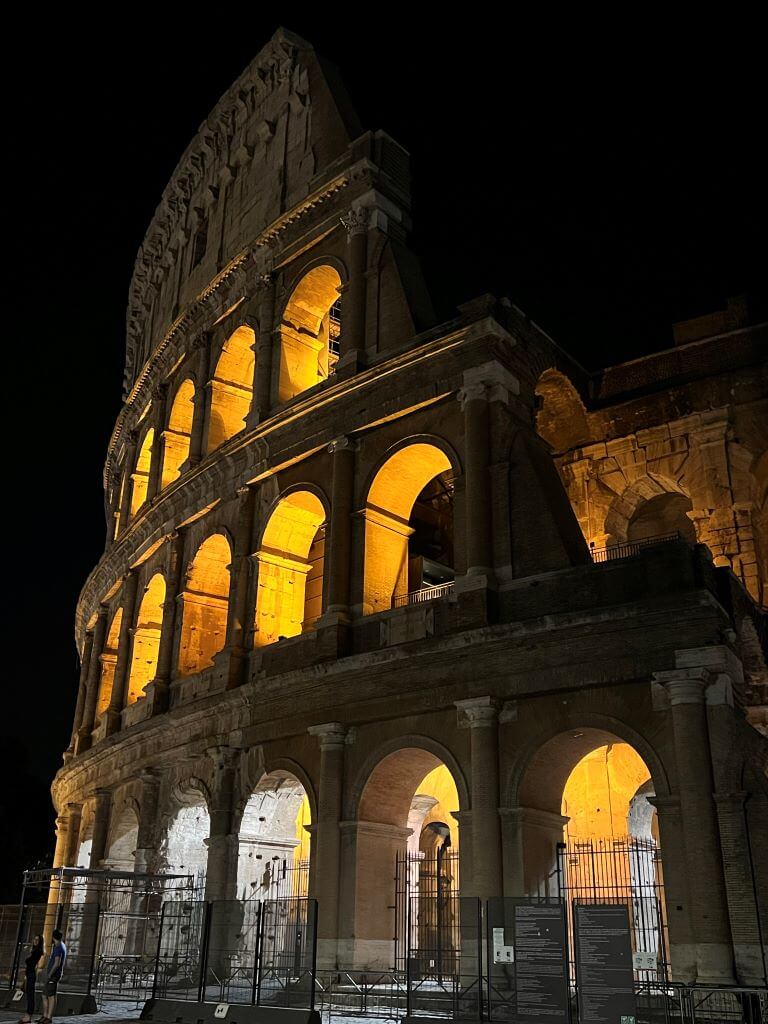
This last part of the tour isn’t vital, but I highly encourage trying to make time to come back to the Colosseum after the sun goes down. In general, Italy does a fantastic job at lighting its monuments to add an extra sense of wonder at nighttime. The Colosseum takes things to another level, though.
The Colosseum is lit from the inside, making its various arcades and archways glow with a soft orange light. It creates a magical effect that seems to bring its millennia-old stone blocks back to life.
Visiting at night also allows you to take in the Colosseum’s vastness unobscured by the throngs of people here during the day. It’s a great way to get one last bit of wonder out of your time with this ancient building.
Ticket Options for My Self-Guided Colosseum Tour
Before getting into the various ticket options, I first want to discuss where you should buy your tickets for visiting the Colosseum. A quick search online shows a huge number of websites selling Colosseum tickets, but only one of these, Coop Culture, is the official ticketing site. For the cheapest prices and most secure checkout process, I encourage you to use Coop Culture for your tickets.
The ticket with the best value is the Full Experience Ticket offered by Coop Culture. With the Full Experience Ticket, you get access to everything described above: the arena floor, the second floor of the Colosseum and the museum. With this ticket, you can also visit the Roman Forum, Palatine Hill, the Imperial Forums, and several other smaller sights over a 48-hour span. Perhaps most importantly, though, you’re able to reserve a time to visit the Colosseum allowing you to skip the line to enter.
You have two other primary ticket options to consider when deciding how to visit the Colosseum. The first is basically the same but with the inclusion of the Colosseum’s Underground, the space where gladiators prepared and exotic animals were kept. Tickets for this are very limited and almost always need to be bought in advance. If you want to see the underground, keep checking Coop Culture’s page for when they become available on the date you’ll be visiting.
The €18 standard ticket includes only the second level of the Colosseum and the museum. It also allows you to visit the Roman Forum, Palatine Hill and the Imperial forums but only over a 24-hour window.
Tips for My Self-Guided Colosseum Tour
Visiting the Roman Colosseum is pretty straightforward, but there are a few things to keep in mind to make your self-guided Colosseum tour go as smoothly as possible.
Book your tickets in advance! This is the most important tip to help make your visit to the Colosseum a smooth one. The Colosseum is one of the world’s greatest tourist attractions. As such, it should be no surprise to read that it can get busy. By booking a ticket in advance, you can skip the line to enter, saving you the time and stress of having to wait.
Bring comfortable clothes and shoes. The Roman Colosseum actually has a fair bit of shade compared to other Roman ruins, but you’ll still find yourself in the sun quite a bit. You will also be on your feet for the whole time you’re visiting the Roman Colosseum. Because of this, you want to dress comfortably to stay as cool and comfortable as possible.
Bring sunscreen and a hat or sunglasses. As I just said, you’re going to be in the sun for part of your visit of the Colosseum. Having sunscreen on hand will help to protect yourself from the sun. A hat and/or sunglasses aren’t as important here, but if it’s particularly bright or your sensitive to sunlight, they could be helpful.
Have water handy. Not to belabor the point, but it can get hot in Italy. Staying hydrated will help keep your visit pleasant and enjoyable.
Other Things to do After Your Self-Guided Colosseum Tour
You have no shortage of other things to do near the Colosseum, especially if you are interested in Ancient Rome. After you’re done with the Colosseum, head over to the Roman Forum just a short 5-minute walk away. Whereas the Colosseum was where Romans went to have fun, the Forum was where they went to get things done. You can explore the various ruins while walking along the same roads as the Ancient Romans.
Before leaving the Forum, head up to the Palatine Hill to see more Roman ruins. This hill was where many of the Roman emperors lived. While the ruins are more broken down than the Forum’s, it’s still an interesting place to wander around without all the crowds of the Forum. You can also see the remains of the famed chariot racing circuit, the Circus Maximus, from Palatine Hill.
Either on your way to or from the Colosseum, you’ll head over the Imperial Forums. These ruins from Ancient Rome are what remain of various markets and governmental buildings. It’s easy enough to see them from Via dei Fori Imperiali, but with your Colosseum ticket, you can enter the forums for a closer look.
I also recommend checking out the Capitoline Museum if you have time. The Capitoline Museum sits on the hill on the northwestern edge of the Roman Forum. Here, you can find statues and artworks from Ancient Rome. It’s a nice change of pace from visiting the grand ruins you’ve seen everywhere else.


If you’re in the mood for even more Roman ruins, head to Pompeii to see an entire ancient city. It takes about two hours to reach by train, but it’s well worth the visit if you have the time.
Frequently Asked Questions About Visiting the Colosseum
When is the best time to visit the Colosseum?
If you can, try to visit in the shoulder months of May and September. July and August bring the hottest weather and the biggest crowds. June is a good option if you can’t visit in May or September.
You should also try to visit early in the day to avoid the biggest crowds. If you purchase tickets ahead of time to skip the line, this isn’t as important, but it can still help to make your visit a bit more enjoyable if you’re concerned about big crowds.
Where should I stay nearby?
We stayed at Arch Rome Suites, and I highly recommend it for your stay in Rome! This hotel sits just a few steps away from the Pantheon and about a mile from the Colosseum. Besides being close to two of Rome’s most popular attractions, it also sits in an alley surrounded by cafes. Despite that, the rooms are quiet, providing a perfect spot for a bit of rest and relaxation in the middle of a busy day.
Should I book a tour to visit the Roman Colosseum?
I don’t think a tour is necessary for the Colosseum. Despite the Colosseum’s huge size, it’s actually a fairly compact visit. With a good blog post (*ahem*) as your guide, you should be okay by just doing a bit of research beforehand.
However, if you do want a more personalized tour, consider the one below! This tour includes the Roman Forum and Palatine Hill and allows you to skip the lines at each sight. It has great reviews on GetYourGuide, having received 4.5/5 stars over 23,000 people who have taken it in the past.
Even though Coop Culture is the official site, it does tend to sell out very quickly. This can make it difficult to get tickets for some people. If that is happening to you, then the safest bet may be to book a guided tour.
Thank you for reading this post. Paul Passing Through is a labor of love to which I’ve dedicated a lot of free time. If you’d like to show your support for my blog, you can Buy Me a Coffee to help fund the future of Paul Passing Through. I appreciate any contributions!
Book Your Trip to Rome
Whether you’re looking for tours, hotels or flights, here are some tools to help get you started planning your trip to Rome!
Look for activities and tours offered through GetYourGuide or Viator!
Search Flights
Still can’t find what you’re looking for? Check out my travel essentials pages for more of my recommendations.
Pin This Post!


