Visiting the Ancient Ruins of the Roman Forum and Palatine Hill
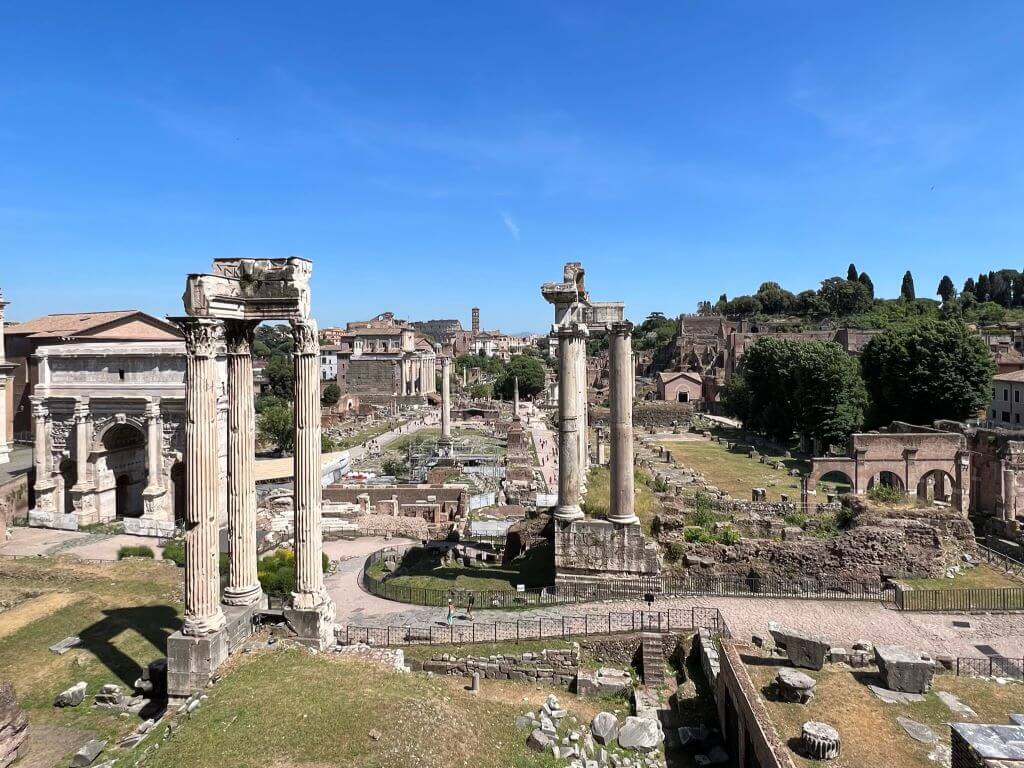
In a city filled with history, the Roman Forum and Palatine Hill are hands down two of the most important sites in Rome. As you walk through the Forum, you are literally walking on the same paths that Roman emperors and politicians walked on to create their vast empire. Up on the Palatine Hill was where the emperors made their home.
It’s not a stretch to say that a visit here is essential for anyone who has even the slightest interest in history. Even if you’re not interested in history, the Roman Forum is still a sight to behold. Its ruined temples and palatial buildings capture the imagination of what this ancient civilization might have looked like.
But first you have to plan your visit in order to make the most of your time. That’s where this guide comes in. In this post, I’ll share with you what to expect while visiting, a handy guide to the ruins themselves and some tips to make your visit to the Roman Forum and Palatine Hill an enjoyable one.
Disclaimer: This post may contain affiliate links. If you make a purchase through one of these links, I will earn a small commission. This occurs at no added cost to you.
History of the Roman Forum and Palatine Hill
The history of Rome starts with the Palatine Hill. According to legend, this hill was where the founders of Rome, Romulus and Remus, were nurtured by the she-wolf Lupa.
Romulus eventually created his own small kingdom on the Palatine Hill and created an alliance with Titus Tatius, the leader of a competing tribe on the Capitoline Hill. Between the two sat a swampy valley with one dry area on its northern end. This spot was where the two groups supposedly laid down their weapons and formalized an alliance. Over time, it became a designated meeting point for different groups of people in Rome.
Whether any of that is true or not, excavations have shown that the two hills did have communities of people who became the first Romans. These people used the area that became the Forum as a cemetery as far back as the 10th century B.C. Around the 8th century B.C., archaeologists believe the area changed from a cemetery to a public site.
Over time, the valley was drained, the ground raised to prevent flooding, and roads and buildings began to be constructed. Particularly around the late 7th century B.C., development of the area began to increase. Unlike later forums in the city, the Roman Forum was developed somewhat piecemeal, with new buildings and monuments being placed next to existing structures. This is why it can seem as if the Roman Forum is a maze of buildings today.
Temples and governmental buildings were continually built in the Forum. As such, it naturally became the center of Roman life. Another result of this development was that the adjacent Palatine Hill became the home of wealthy Romans.
Much of this culminated during the reign of Rome’s first emperor, Augustus. He established his palace on the Palatine Hill, a tradition that future emperors continued (the word palace comes from the Palatine Hill). He also created the Forum’s final general form by developing its southeastern section.
After the fall of Rome, the buildings in the Roman Forum and Palatine Hill gradually fell into disrepair. Some were even demolished to provide building materials for other areas around Rome. There were varying periods of time where preservation of the Forum was attempted. Nevertheless, it wasn’t till the 19th century when excavations and preservation attempts began and were maintained in earnest.

Guide to the Roman Forum
| Hours | Opens daily at 8:30 and closes one hour before sunset |
| Length of Visit | 1 -2 hours |
| Cost | €24 (Full Experience Ticket) |
| Highlights | The feeling of walking back in time to the Ancient Rome era |
The Roman Forum is perhaps the most important public space in Western civilization, if not the entire world. Romans celebrated victories and, more importantly, decisions that would affect the empire were made here. With time and patience, it’s possible to trace important events during world history back to their roots here.
Many of these same stones you’re walking on would have been walked on by important figures like Julius Caesar, Emperor Augustus and Marc Antony. The many sights are impressive, but the Roman Forum imparts a sense of awe and wonder that permeates the air around this millennia-old space. You can practically hear the echoes of the Roman Empire as you make your way through the Forum.
At one point, I stopped, turned to Michelle and exclaimed, “This is just so freaking cool!” I couldn’t find words to describe how incredible it felt to be walking through such a historic place.
Below are some of my personal highlights from the Roman Forum. However, I loved all of it, so this is more so a sampling of what to expect when visiting!
Arch of Titus
If you’re coming from the Colosseum, the Arch of Titus is the first monument in the Roman Forum you’ll see. It marks the entrance to the Forum, and what an entrance it is!
The Arch of Titus was built in 70 A.D. to commemorate the Roman victory over Israel. By itself, the arch is only so-so when compared to the nearby Arch of Constantine and the Arch of Septimius Severus, but what I found most memorable from this one was the moment I passed by it into the Forum. It was like walking through the looking glass. On one side was our modern world, on the other side was the ancient world.
As you pass through here, take a moment to remind yourself that many of the monuments and buildings would have had vibrant colors to them instead of the white we see today. When future Romans used stone from the Forum for their own buildings, the colored marble was typically the first to go. Meanwhile, the elements gradually wore away any paint on the monuments.

Temple of Antoninus Pius and Faustina
The Temple of Antoninus Pius and Faustina is one of the best-preserved buildings in the Roman Forum. Like many other temples, it was converted into a Christian church, which helped it to escape ruination.
Despite its preservation, you can still see where possible looters tried to remove the temple’s Corinthian columns. Look for cuts in the marble towards the top of the columns. These are where people attempted to cut through the marble to pull them down with rope.
Interestingly, the base of the green door is where street level in the Roman Forum was during the Renaissance. Sediment and rock built up over the centuries to cover the temple’s staircase and the rest of the Forum.

House of the Vestal Virgins
Opposite the Temple of Antoninus Pius and Faustine is the Temple of Vesta and the House of the Vestal Virgins. The Temple of Vesta was a circular building that housed a sacred flame, itself a symbol of Rome’s prosperity. This fire was kept alight 24/7 by the Vestal Virgins. This was a group of six priestesses who represented the goddess Vesta and were highly regarded in Roman society.
The Vestal Virgins lived next to the temple in the House of the Vestal Virgins. Not much remains from the Vestal Virgins three-story palace beyond the inner courtyard. This courtyard mesmerized me, though.
It’s an enchanting oasis in the Forum’s otherwise dusty, dry confines. The palace’s courtyard held two small pools, still filled with water today. When we visited, each pool was surrounded by gorgeous pink and white flowers. It was a delightful spot in the Forum to rest, both physically and mentally, from everything else.

Temple of Castor and Pollux
This is perhaps the most photogenic spot in the Roman Forum. These three columns close to the Temple of Vesta are the remnants of the Temple of Castor and Pollux.
The Temple of Castor and Pollux was built in the 5th century B.C. to celebrate the Roman’s victory over a dictatorial Etruscan ruler, Tarquin. This spot is believed to be where two heroic figures from the battle, Castor and Pollux, stopped to water their horses after the day was won.
Like everything else, these three massive columns and their pediment are a sight to behold. They are recognizable, but that doesn’t make them any less memorable.

Temple of Julius Caesar
This small space in the Roman Forum to the right of the Temple of Castor and Pollux can be easily overlooked, but that belies its significance. Julius Caesar was cremated in this spot after his assassination in 44 B.C. This is also where, according to Shakespeare at least, Marc Antony gave his “lend me your ears” speech during Caesar’s funeral.
A temple was built here in 29 B.C. after Rome added Caesar to their roster of gods. The temple is mostly gone at this point, but if you look behind the stone wall you can see the remains of a small platform where speeches by Romans were given. People treat this spot as Caesar’s de facto grave. You will likely see fresh flowers placed there during your visit to commemorate this historic figure.
Arch of Septimius Severus
The Arch of Septimius Severus was built in 1998 A.D. to commemorate the wizard who gave his life to protect Harry Pot…wait, no, that can’t be right.
(Sorry! I couldn’t help myself!)
The Arch of Septimius Several was actually built in 203 A.D. in honor of Emperor Severus’ victory against the Parthinians of ancient Iran. This arch is tucked away into a back corner of the Roman Forum which makes it almost seem like it isn’t worth seeing. This placement is a testament to the organic way the Forum grew over the years.
Make sure you take the time to head all the way to the back of the Forum to admire the Arch of Septimius Severus. It’s adorned with reliefs depicting Rome’s victory in this battle, including detailed images of the victors bringing their spoils from the war back to the capital.

Temple of Saturn
Another of the Roman Forum’s more picturesque ruins is the Temple of Saturn. This iconic structure marks the front portico of Forum’s oldest temple. The original temple was built in 497 B.C. and then reconstructed in 42 B.C. after the original burnt down. It was rebuilt a second time in 360 A.D. after suffering another fire.
Similar to the Temple of Castor and Pollux, the remaining edifice of the Temple of Saturn remains standing as a testament to Rome’s perseverance.

Guide to Palatine Hill
| Hours | Opens daily at 8:30 and closes one hour before sunset |
| Length of Visit | 30 – 60 minutes |
| Cost | €24 (Full Experience Ticket) |
| Highlights | Views of the Forum, a quiet stroll through Roman ruins |
After spending the bulk of your time in the Roman Forum, climb up the stairs near the Arch of Titus to explore the Palatine Hill. You could also enter from Via di San Gregorio if coming here first.
The ruins here are scant compared to the Forum below, but you can still find a few things of interest. If nothing else, visiting the Palatine Hill is worth the effort for two reasons.
First, the view of the Roman Forum from the Palatine Hill is incredible! You’re able to see all the ruins in one sweeping panoramic view. To your left is the Capitoline Hill and to your right is the Colosseum. In between the two lays the Forum in varying degrees of ruin. It’s one of the best views in Rome and shouldn’t be missed.
Second, even if you don’t plan to visit any of the more substantial ruins on the Palatine Hill, a visit here still makes for a nice relaxing stroll away from the bigger crowds of the Forum. This is basically what we did, and while I would have liked to have seen more, I still enjoyed the time we spent here.
If you want to do a bit more sightseeing in addition to what I mentioned above, here are some of the highlights to see on Palatine Hill.

After seeing the Roman Forum, you’re almost certainly going to be getting exhausted by now. I recommend finding any of these highlights you want to see on a map and heading to them first. Palatine Hill isn’t huge, but it can be a lot of walking if you are wandering aimlessly. We made that mistake and missed most of the main sights asides from the Farnese Gardens and Huts of Romulus.
Farnese Gardens
The Farnese Gardens are the remains of an even larger garden created by the Farnese family in the 1500s A.D. In addition to the vineyards and ruins that were already there, they added monuments, fountains and rare plants.
We walked a bit through the pleasant gardens before heading towards the Huts of Romulus. It was a lovely change of pace from the dusty, brown of the Forum.

Huts of Romulus
These ruined huts were found in the early 20th century and are believed to be the remains of the home where Rome’s founder, Romulus, lived.
It’s interesting to see in the sense of the history it imparts, but aside from that, there frankly isn’t much to see. If you have plenty of time or else want to get far from other tourists, check out the Huts of Romulus. Otherwise, your time could be better spent elsewhere.
Circus Maximus
The backside of Palatine Hill overlooks the famed Circus Maximus. This space is the site of what was the largest stadium in Ancient Rome. It was primarily used for chariot racing, but it also played host to other events like religious ceremonies, beast hunts, gladiator fights and more.
You can’t access the Circus Maximus from Palatine Hill. However, like the views of the Roman Forum from here, this is one of the best ways to see the stadium.
Palatine Museum
The Palatine Museum is a small museum containing statues, frescoes and other historical objects found on the hill. Its objects span over 15 centuries of Roman history. This museum could be a nice addition to provide some context to the ruins you’ve been walking around during your visit.
Imperial Palace
This large imperial palace, also referred to as the Domus Flavia is the main highlight on Palatine Hill. The palace was built by Emperor Domitian in 92 A.D. near the residence of former Emperor Augustus. Over the years of the Roman Empire, future emperors lived here and made their own additions and modifications.
The palace is one of the largest and best-preserved ruins on the Palatine Hill. As such, it could be worth seeing early on in your visit to the hill before you go around to see some of the lesser sights.
Tips for Visiting the Roman Forum and Palatine Hill
A visit to the Roman Forum and Palatine Hill can be exciting but exhausting, especially if you were at the Colosseum earlier in the day. Below are some important tips to help make your visit an enjoyable one.
Book your tickets in advance! I can’t stress that enough. Whatever ticket option you decide to go with, purchase it online ahead of time so you can skip the line to get in. This will save you time and the stress of having to wait in a potentially long line.
Wear comfortable clothes and shoes. You can expect to be on your feet for at least two hours while visiting the Roman Forum and Palatine Hill. Almost that whole time will be spent in the sun, which especially if you’re visiting in summer, can be brutally hot. Wearing comfortable, light clothing will help mitigate the heat. Additionally, comfortable yet sturdy shoes are equally important due to the sometimes uneven, dusty ground you’ll be walking over.
Bring sunscreen and either a hat or sunglasses. As mentioned above, don’t expect much shade to hide under from the hot Italian sun in either the Forum or Palatine Hill. It’s important to have sunscreen to protect yourself and either a hat or sunglasses to make it easier on your eyes to take in all the fantastic ruins.
Have a reusable water bottle handy. Similarly, make sure to bring water with you. No matter how well you prepare with the above tips, you’re likely still going to get hot and sweaty while visiting here. Fortunately, there are free public water fountains around the Forum for you to keep yourself refreshed.
Ticket Info for the Roman Forum and Palatine Hill
The internet has a wide range of websites offering tickets for the Roman Forum and Palatine Hill. The official ticketing site is Parco Archeologico Colosseo. Since it’s the official ticketing site, it has the cheapest prices and the most security when purchasing your tickets. If you’re interested in booking a tour, GetYourGuide and Viator offer several ticket options to consider.
Getting to the Roman Forum and Palatine Hill
The Roman Forum has two different entrances. The first is near the Colosseum. If you’re exiting the Colosseum, walk past the Arch of Constantine with it on your left and keep going straight. You’ll almost certainly see crowds of people walking in this direction, so it’s hard to miss. If you aren’t visiting the Colosseum first, just go up to the Arch of Constantine and turn right.
You can also enter the Roman Forum near the intersection of Via Cavour and Via dei Fori Imperiali. This entrance is likely to have shorter lines if you didn’t purchase your ticket ahead of time.
The closest metro station to either entrance is Colosseo. If you’re taking the bus, get off at the Colosseo station if entering near the Colosseum or the Fori Imperiali station if entering near Via Cavour.
Other Things to do Near the Roman Forum and Palatine Hill
With the Roman Forum’s location in the heart of Ancient Rome, you have no shortage of things to see within a short walk. The most significant of these is the Colosseum just a couple minutes from the Forum’s Arch of Titus entrance. What’s more, if you purchased the Full Experience Ticket to see the Roman Forum and Palatine Hill, the Colosseum is included in that ticket.
Overlooking the Forum is the Capitoline Museum where you can see many of Ancient Rome’s most important statues and other works of art. After seeing the grand spectacle of the Roman Forum, the Capitoline Museum is a nice change of pace where you can see some of the smaller details from the era.
On your way to or from the Roman Forum, you’ll also pass over the Imperial Forums. While not as important as the Forum, these Roman ruins are interesting to see, nonetheless. With any of your tickets to the Roman Forum, you can enter the Imperial Forums to see them up close, but you can also easily see them from a slight distance while walking along Via dei Fori Imperiali.


Frequently Asked Questions About the Roman Forum and Palatine Hill
When is the best time to visit the Roman Forum and Palatine Hill?
The best time to visit is the months of May and September for the nicest weather while avoiding the onslaught of the summer tourist summer season. June can be a suitable option, too, if you have to visit during summer as you should still avoid the hotter months of July and August.
Can I visit just one of these two sights?
Yes, but if you want to visit both the Roman Forum and Palatine Hill, you have to see them both in the same visit. For instance, even if you have the Full Experience Ticket, you can’t see the Roman Forum on one day and Palatine Hill the next.
Where can I stay nearby?
Arch Rome Suites is just a quick walk from the Roman Forum’s Via Cavour entrance and a pleasant stay in the thick of things in Rome. This hotel is located on a small alleyway within steps of the Pantheon and several bars and cafes. Despite that location, the rooms themselves are quiet, comfortable and filled with more modern amenities. They also offer an included continental breakfast.
Would a guided tour be helpful?
Booking a guided tour is an option, especially if you don’t want to or don’t have the time to do much research beforehand. I did a decent amount of research and had a guidebook handy, so I felt like I was able to do a good job guiding Michelle and myself around. We still enjoyed it and got a lot of out of it, but we definitely missed some things. So, it’s certainly possible to do without a tour even if it’s your first time visiting (unlike Pompeii, for instance). It just depends on how much you want to get out of your visit.
Thank you for reading this post. Paul Passing Through is a labor of love to which I’ve dedicated a lot of free time. If you’d like to show your support for my blog, you can Buy Me a Coffee to help fund the future of Paul Passing Through. I appreciate any contributions!
Book Your Trip to Rome
Whether you’re looking for tours, hotels or flights, here are some tools to help get you started planning your trip to Rome!
Look for activities and tours offered through GetYourGuide or Viator!
Search Flights
Still can’t find what you’re looking for? Check out my travel essentials pages for more of my recommendations.
Pin This Post!